How to Plan a Capsule House Resort Step by Step
Eight stages of planning a capsule house resort - positioning, site, unit mix, finance, approvals, procurement, build and operations - with deliverables.

Planning a capsule house resort is a sequence of eight decisions, and the sequence matters more than the speed. Projects that struggle almost always skipped a stage or ran two in parallel and then had to unwind one. This page is a process map: it tells you what each stage is for, what it must produce, and where the detailed work is described. It deliberately does not repeat the detail - each stage links to a dedicated article.
Stage 1: Positioning and Guest Profile
Everything downstream is a consequence of who you are building for, and this is the stage most often treated as a formality.
- Define the guest: couples, families, groups, remote workers, or event attendees.
- Decide the proposition: novelty-led, nature-led, or amenity-led.
- Set the price band you intend to hold, and check it against comparable local inventory.
- Decide seasonality expectations honestly - whether you aim for year-round or shoulder-season operation.
Deliverable: a one-page positioning statement with a target nightly rate, target occupancy and a named guest type. If you cannot write it in one page, the later stages will be argued about repeatedly.
Stage 2: Site Selection and Land Evaluation
Site determines cost, programme and what is legally possible, and it is the least reversible decision in the project.
- Confirm land classification and what the classification permits.
- Evaluate access for construction traffic and, later, for guests.
- Assess ground conditions, slope, drainage and exposure.
- Check utility availability and the realistic cost of extending it.
Deliverable: a site feasibility note with a yes or no, and a list of conditions attached to the yes. Our site selection and land evaluation guide covers this stage in full.
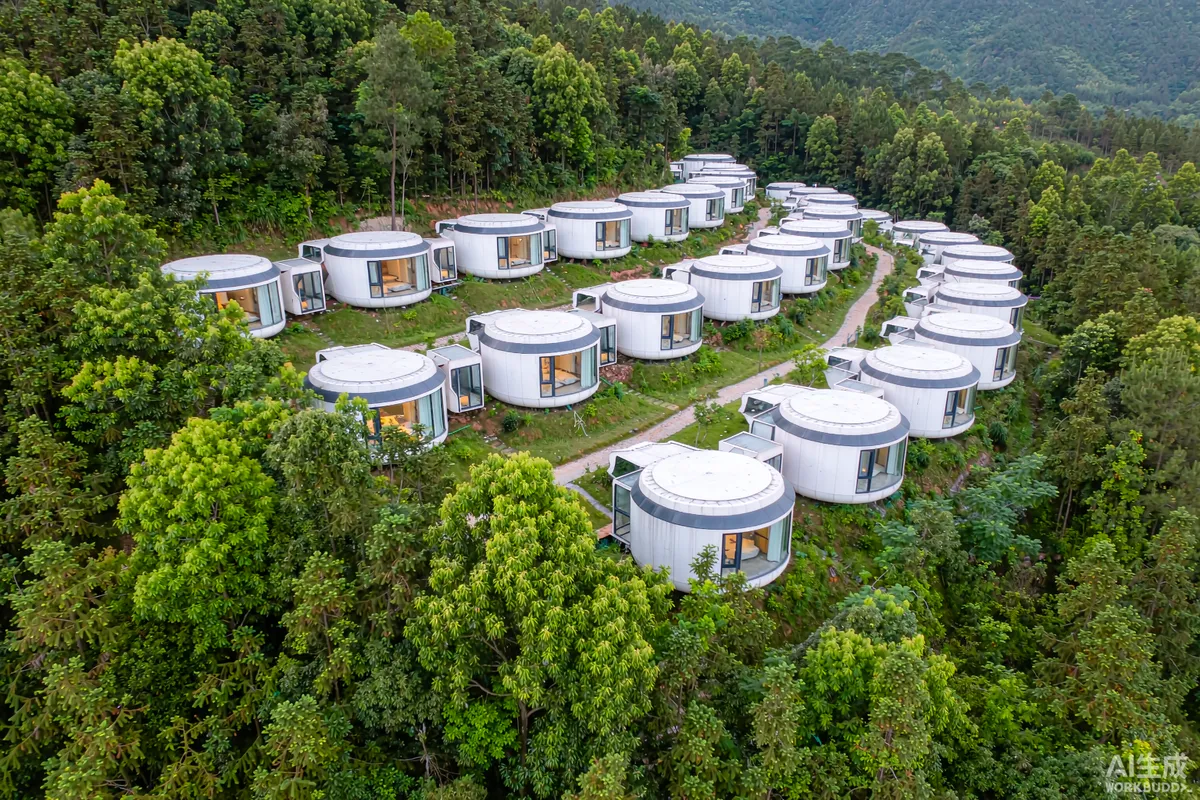
Stage 3: Unit Mix and Quantity
How many units, of which size, arranged how. This is a commercial decision expressed in physical form.
- Size the cluster to the demand you established in stage 1, not to the land available.
- Choose a mix - compact, mid-size and larger units serve different booking types.
- Plan spacing for privacy, outlook and service routes.
- Decide whether to phase, and if so, what the first phase must include to operate standalone.
Deliverable: a site layout plan with unit positions, types and a phasing boundary. Detail: resort site layout and phased expansion.
Stage 4: Investment and Operating Model
Numbers that survive contact with the first year of trading. Two separate models are needed: what it costs to build, and what it costs to run.
- Capital: units, freight, site works, utilities, shared facilities, professional fees, contingency.
- Operating: staffing, utilities, cleaning, maintenance, marketing, platform commissions, consumables.
- Revenue: nightly rate against realistic occupancy, including the seasonal shape.
- Sensitivity: what happens if occupancy comes in below plan.
Deliverable: a capital budget and an operating projection with stated assumptions. Detail: budget line items and the resort ROI model.
Stage 5: Approvals and Permits
Start this in parallel with stage 3, because it frequently changes the layout.
- Establish which consents apply: planning, building, environmental, tourism or hospitality licensing, fire safety.
- Establish how the units are classified locally - this single question drives most of the rest.
- Engage the authority early with drawings, rather than submitting at the end.
- Build the approval timetable into the programme as a real duration.
Deliverable: a consent register listing each approval, its status and its expected date. Requirements may vary by market and applicable local regulation; confirm with the relevant authority rather than inferring from another project.
Stage 6: Procurement and Production
Ordering is not the start of this stage - specification is.
- Freeze the specification before requesting quotes, so quotes are comparable.
- Request quotes in a common format; undefined scope is the main source of apparent price differences.
- Confirm production slot, lead time and progress reporting arrangements.
- Book freight and confirm route and access constraints while there is still time to change them.
Deliverable: a signed specification, a comparable quote set, and a production and shipping schedule. Detail: requesting comparable quotes and the first-order checklist.
Stage 7: Site Works and Opening Preparation
The physical programme, and the part where stage 2's conditions either hold or do not.
- Complete site works, foundations and services before units arrive.
- Sequence delivery against completion, not against optimism.
- Commission every unit individually and record it.
- Prepare operations: staffing, housekeeping, check-in, maintenance routines.
Deliverable: a commissioned site with a handover pack, and an operations manual. Detail: installation and handover documentation.

Stage 8: Operations and Iteration
The first season generates the information needed to make the project work properly, and it should be captured deliberately.
- Track occupancy, rate and review content together - they explain each other.
- Log every maintenance issue against the unit and the component.
- Feed recurring guest comments back into specification for the next phase.
- Revisit the financial model against actuals before committing to a second phase.
Deliverable: a first-season review that changes the specification or the operating model. Detail: turning guest feedback into specification improvements.
What a Deliverable Is, and Why It Matters
Every stage above ends with a named deliverable, and that is not administrative tidiness. A stage without a deliverable has not finished, however much work has been done on it, and the next stage will be built on an assumption rather than on a result.
- A deliverable is testable. "Site assessed" is not one. "Site feasibility note listing three conditions attached to a yes" is.
- A deliverable has an owner. Someone signs it, which is what makes it possible to ask a question later.
- A deliverable is dated. Programmes slip in the gaps between verbal agreements, and dates make those gaps visible.
- A deliverable gates the next stage. If stage 4 begins before stage 3's layout is signed, the budget is being produced against a moving target.
The discipline is uncomfortable on small projects because it feels formal, and it is exactly what prevents the second-guessing that consumes most of the time on a resort development. Two documents - the positioning statement and the consent register - do most of the work.
How Long the Whole Thing Takes
Durations vary widely, but the shape of the programme is consistent and it is worth internalising before committing to an opening date.
- Stages 1 and 2 - positioning and site - typically take longer than expected, because land and consent questions are rarely resolved on the first attempt.
- Stage 5 - approvals - is the most variable stage in the entire programme and the one least under the developer's control. It should be treated as a duration with a range, not as a date.
- Stage 6 - production and shipping - is usually the most predictable stage, because it is contractual. Its duration is set by the production slot and the shipping schedule, both knowable in advance.
- Stage 7 - site works - is where the site conditions identified in stage 2 are either confirmed or found wanting.
The practical consequence: an opening date should be set backwards from the approvals timeline, not forwards from the order date. Ordering units before the consent position is understood is the most common way to turn a predictable stage into an expensive one, because storage and demurrage costs then accrue while the paperwork catches up.
Who Needs to Be on the Team
Capsule resort projects are small enough that owners often try to run them without professional support, and that is where the avoidable costs come from.
- A local land-use or planning professional for stages 2 and 5. In most markets this is not optional.
- A local engineer for foundation and anchoring design, since these depend on ground conditions and local code.
- A cost advisor for stage 4 where the project is externally financed.
- An operations lead engaged during stage 3, not after stage 7 - layout decisions carry operational consequences that are much cheaper to change on paper.
- A named person at the factory for specification, drawings and progress reporting.
Common Sequence Errors
These four account for most of the programmes that go wrong, and each is a sequencing mistake rather than a technical one.
- Ordering before classification is known. If the local authority treats the units differently from what was assumed, the specification, the foundation and sometimes the site plan all change.
- Designing layout before the services strategy. Where power and water come from determines where units can go, and retrofitting a services route through a finished layout is expensive.
- Fixing the opening date before the consent timeline is understood. This is the error that produces storage costs and rushed commissioning.
- Skipping the first-season review and going straight to phase two. The second phase is the opportunity to fix what the first revealed, and it is wasted if nothing was recorded.
Two Rules That Prevent Most Problems
- Do not start stage 6 before stage 5 has an answer on classification. Ordering units before knowing how they will be classified locally is the most expensive shortcut available.
- Do not start stage 7 before stage 2's conditions are met. Site works begun on an unresolved site generate change orders, not progress.
One further caution on ordering. It is tempting to run procurement early because production lead times feel like the longest item in the programme - they are visible, and they are contractual. Approvals, by contrast, produce no artefact until they conclude, which makes them easy to postpone and dangerous to postpone. If two stages must overlap, overlap approvals with design rather than procurement with approvals.
The stages are sequential for a reason: each produces the information the next one consumes. Running them in parallel saves time only when the earlier stage is genuinely settled. If you want a second opinion on your sequence, share your site and programme and we will comment on the ordering before you commit to procurement.
More from the Blog

Capsule Home Cost Guide: What You Really Pay in 2026
EXW, shipping, install and the hidden line items — a transparent breakdown of total landed cost.
Read article →
How to Install a Capsule Home in 3 Days: A Step-by-Step Guide
From site prep to first guest — the exact sequence our install crews follow on every deployment.
Read article →
Real Owners, Real Numbers: Success Stories
How a lakeside resort, a Spanish glamping site and a Singapore dealer hit their targets.
Read stories →Talk to the Factory
Ready to Ride the 2026 Wave?
Get the latest catalog, pricing tiers and a layout sketch for your land — straight from the engineering team.