Capsule House Smoke Season Thailand: HVAC Plan
Capsule house smoke season in Thailand: fresh air intake and filtration, positive pressure limits, higher cleaning load, longer indoor hours and honest rates.

Northern Thailand has a recurring smoke season during the driest part of the year, driven by agricultural burning and regional haze. For a resort operator it is not a one-week event; it is a predictable multi-week window with operational consequences. This page covers what changes for a capsule unit in that window: fresh air strategy, filtration, maintenance load, guest communication and pricing. The year-round Thai picture sits on our capsule house Thailand page, and the rain-season building envelope is on our waterproofing page.
Treat It as a Season, Not an Incident
The most expensive mistake is responding to smoke season as if it were a storm. A storm is an event with a beginning and an end; a smoke season is a recurring part of the operating calendar. Planning for it changes the specification, not just the housekeeping rota.
- Fresh air intake location and filtration are decided when the unit is specified, not when the air turns brown.
- Filter spares are purchased in advance, because a filter that must be ordered during the event is a filter that arrives after it.
- Cancellation and pricing policy is written before bookings exist, so guests know what they are buying.
- Staffing and maintenance windows are built around higher indoor occupancy, because guests stay inside more.
The general science of air exchange, filtration grades and ventilation rates is on our air quality and filtration page. This page stays with the seasonal decisions specific to northern Thailand.
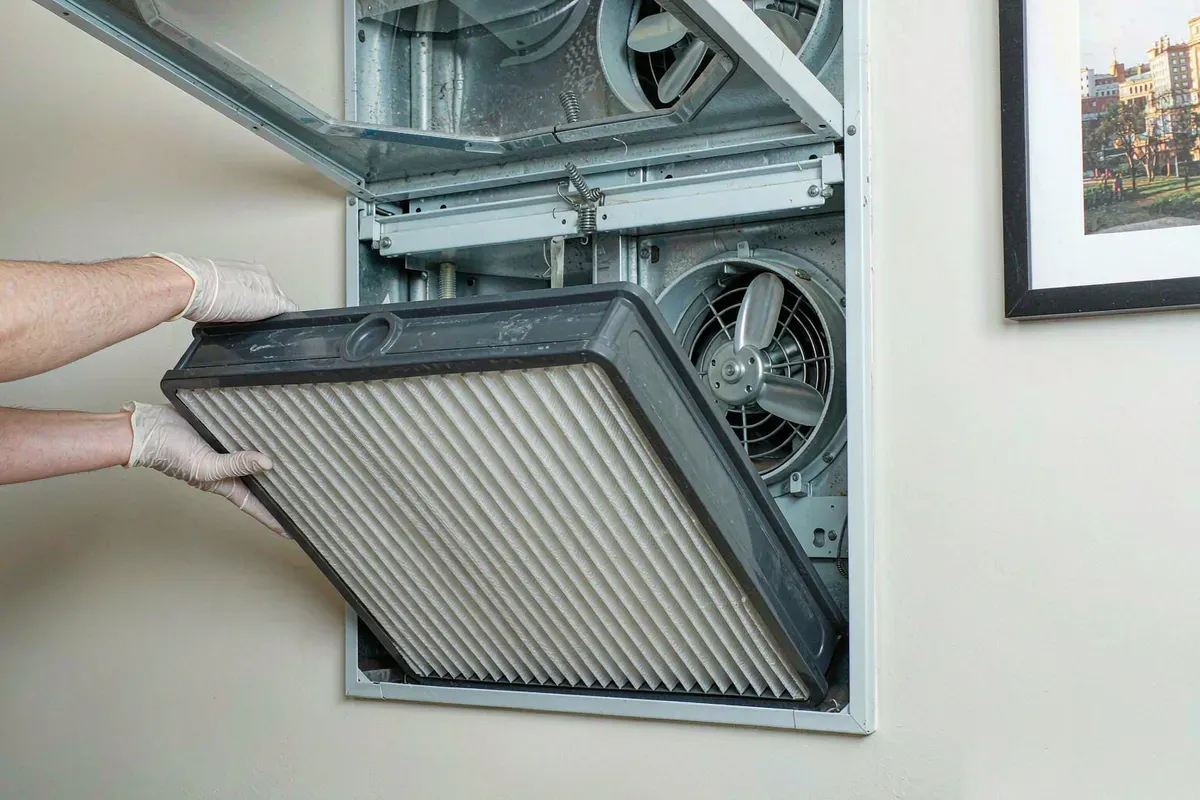
Fresh Air: Where You Take It From Matters
During a smoke window the question is not whether to filter, it is where the intake sits and what grade sits behind it. Three practical points:
- Intake siting. An intake on the leeward side, away from road dust and away from any burning activity nearby, sees a lower particulate load than one facing the prevailing dry-season wind. Confirm the local prevailing direction rather than assuming.
- Two-stage filtration. A coarse, washable pre-filter protects the finer media behind it. In a season with heavy loading, the pre-filter does most of the work and saves you money on the expensive stage.
- Bypass discipline. If the unit can be run with the filter door open or with filters removed "for more airflow", someone will do it. Specify access that makes bypass inconvenient.
Be careful with filtration claims. Ask for the filter's declared efficiency class and its test standard in writing, and match it to the room volume and air changes you actually need. Higher efficiency media raises pressure drop, which costs fan energy and can increase noise — and a noisy bedroom generates complaints of its own.
Positive Pressure Versus Real Behaviour
Sealed buildings stay cleaner because they keep unfiltered air out. Real guest behaviour works against that: doors open repeatedly, and a balcony door left ajar for an hour undoes the design intent.
- Design for partial containment rather than a perfect seal; a modest positive pressure reduces infiltration but does not eliminate it.
- Give guests a reason to keep doors closed — a comfortable indoor temperature and a clear explanation rather than a prohibition.
- Provide a small entry buffer where possible so the main volume is not opened directly to outside air.
- Expect to run mechanical ventilation for longer hours, and size spares and electricity accordingly.
Maintenance Load Goes Up, Both Outside and In
Smoke season leaves residue. It also coincides with the driest part of the year, so dust from unpaved surfaces adds to the load.
| Task | Normal season | Smoke window |
|---|---|---|
| Pre-filter inspection | Monthly | Weekly, or loaded every two weeks |
| Fine media replacement | Per manufacturer interval | Shortened; planned in advance |
| Glazing and deck cleaning | Weekly | Two to three times weekly |
| Interior deep cleaning | Per turnover | Per turnover plus periodic during long stays |
| Fan and coil check | Quarterly | Before season, then after |
Note that I have not quoted particulate concentrations. Measure your own site if you want numbers, and use them operationally rather than in marketing. Avoid making health claims in listings; describe what the unit does mechanically and let guests decide.

Longer Indoor Hours Change the Load
When the outdoor experience is limited, guests stay inside. That shifts three loads at once:
- Ventilation — occupancy hours rise, so fresh air demand rises, exactly when filtering it costs the most.
- Moisture — cooking, showering and breathing in a smaller space for longer raises humidity, which matters when the outdoors is hazy and windows stay closed.
- Amenity expectations — indoor space is scrutinised harder. Lighting, seating and connectivity matter more during the smoke window than in months when guests are outside all day.
Dehumidification capacity is worth thinking about during specification, because a closed, occupied unit in a humid tropical highland or valley setting will generate moisture faster than it is removed by air conditioning alone.
Pricing, Cancellation and Honest Listing Copy
Operators are often advised to hide the smoke season. The better commercial answer is to price and describe it accurately. Cancellation disputes cost more than a discounted rate, and they damage the listing where it matters.
- Describe the season plainly in the listing: roughly when it occurs, what conditions to expect, and what the unit does about it.
- Offer a fair cancellation or rebooking window for the affected dates rather than arguing about whether haze is "weather".
- Adjust nightly rates for the window rather than discounting blindly after complaints arrive.
- Consider packaging the low season: longer stays and work-friendly setups sell better to guests who were going to be indoors anyway.
Policy structure and wording is covered on our cancellation and weather policy page. Whatever you decide, keep it consistent across channels so a guest cannot find better terms on one platform than another.
Briefing Staff and Communicating With Guests
Equipment only performs as well as the people operating it. Two groups need a short written brief before the season starts.
Housekeeping and maintenance. Tell them what changes, and specifically what to look for: filter condition at the stated inspection interval, dust film on glass and decks, doors left propped open, and any guest complaint about smell or noise from ventilation running longer hours. Give a single place to log findings, so a recurring pattern is visible rather than reported verbally each week.
Front of house and reservations. Give them one paragraph of honest language they can reuse: what the season is, roughly when it falls, what the unit does about it, and what the policy is if a guest wants to change dates. Consistency matters more than wording. A guest who receives three different explanations from three channels will escalate, whatever the policy actually says.
Also prepare a small in-unit card. Guests accept a seasonal condition far better when someone has thought about it in advance, and the card should explain why windows are kept closed during the smokiest hours rather than simply instructing them to.
Specification Checklist for Smoke-Prone Regions
- Fresh air intake positioned away from prevailing dry-season winds and local dust sources.
- Two-stage filtration with a washable pre-filter and a declared efficiency class for the fine stage.
- Filter access that is quick to service and awkward to bypass.
- Sealing specified at the frame and penetration level, with a stated air-tightness expectation.
- Dehumidification capacity matched to occupied, closed-window conditions.
- Spare filter stock bought before the season, sized for the shortened interval.
Investment expectations for the Thai market are summarised on our Thailand price page. Requirements for ventilation, filtration and occupancy classification differ by locality and use, so confirm with the authority having jurisdiction: Requirements may vary by application, market and applicable standard.
More from the Blog

Capsule Home Cost Guide: What You Really Pay in 2026
EXW, shipping, install and the hidden line items — a transparent breakdown of total landed cost.
Read article →
How to Install a Capsule Home in 3 Days: A Step-by-Step Guide
From site prep to first guest — the exact sequence our install crews follow on every deployment.
Read article →
Real Owners, Real Numbers: Success Stories
How a lakeside resort, a Spanish glamping site and a Singapore dealer hit their targets.
Read stories →Talk to the Factory
Ready to Ride the 2026 Wave?
Get the latest catalog, pricing tiers and a layout sketch for your land — straight from the engineering team.