Capsule House Price in Thailand: Cost Breakdown
Capsule house price in Thailand as a landed cost: freight, duty and taxes, island haulage, sloping-site works and the two climate lines to specify.

A capsule house price quoted for Thailand is rarely the number you pay to open the door. The factory price is one line in a landed cost that also carries ocean freight, port handling, customs duty and taxes, inland haulage, site works, foundation, utility connection, commissioning and professional fees. This page sets out each line in the order you will meet it, explains which ones you can influence and which you cannot, and flags the Thailand-specific items — wet-season site works and cool-season comfort in the north — that change the build itself. We publish no price figures here; they depend on configuration, route, date and prevailing regulation, and only your suppliers and local consultants can establish them. For the general price framework, see our capsule house price page.
The Landed Cost Structure
Work through the cost as a sequence rather than a single figure. Each line has a different owner, a different degree of certainty and a different sensitivity to decisions you make early.
| Line | Set by | How much you can influence it |
|---|---|---|
| Unit price and configuration | Supplier | High — specification choices move this most |
| Export packing and loading | Supplier | Medium — transport form decided here |
| Ocean freight and insurance | Carrier / market | Low — but route and season matter |
| Port handling and terminal charges | Port | Low — fixed schedules |
| Customs duty and taxes | Authority | Low — but classification is yours to establish |
| Inland haulage to site | Local carrier | Medium — access survey changes the vehicle class |
| Foundation and site works | Your contractor | High — soil and slope drive this |
| Utility connection | Local utility / contractor | Medium — distance to existing services |
| Crane and set | Local contractor | Medium — access and ground bearing |
| Commissioning and snagging | Supplier + your team | Medium — inspection before acceptance |
| Consultant and licence fees | Your advisers | Medium — scope of the approvals work |
The two lines most often omitted from a first budget are inland haulage to a resort site and the foundation. Both are site-specific, both are quoted locally, and neither appears in a factory quotation. Ask for them early, because a site with difficult access or poor soil can move the total more than any unit option.
Freight and Inland Haulage
Thailand has deep-sea ports serving both the Gulf and the Andaman side, and the right gateway depends on where the site actually is. Choose the port by the final destination, not by the ocean rate alone — a cheaper ocean leg into the wrong port can cost more on the inland leg than it saved.
Transport form is decided at the factory and cannot be changed on arrival. A complete unit moves as an out-of-gauge load and needs route permits, escort and a suitable crane. A folded or flat-packed module moves as conventional cargo and is assembled on site. The right choice depends on your site access, which is why the access survey must precede the order. Our capsule house shipping cost page covers how form, route and season interact.
Duty and Taxes: Establish Classification First
Duty and import taxes in Thailand are assessed against the customs value and the classification applied to the goods. The rate that applies is a matter of prevailing regulation and the HS classification your broker establishes. We publish no rates here, deliberately — a rate quoted out of context on a website is exactly the kind of figure that proves wrong.
What you can do is make the inputs accurate and consistent. Ask your broker to confirm, before shipment: the HS code they intend to declare and why, the customs value basis and the declared incoterm, whether freight and insurance form part of the assessable value under those terms, and which taxes apply on top of duty. Then check that the supplier's invoice matches the intended declaration. Our page on import duty and taxes sets out the questions in more detail.
The Two Thai Specification Lines
Thailand imposes two distinct climate requirements depending on region, and a single specification does not serve both well.
Wet Season: Water Management
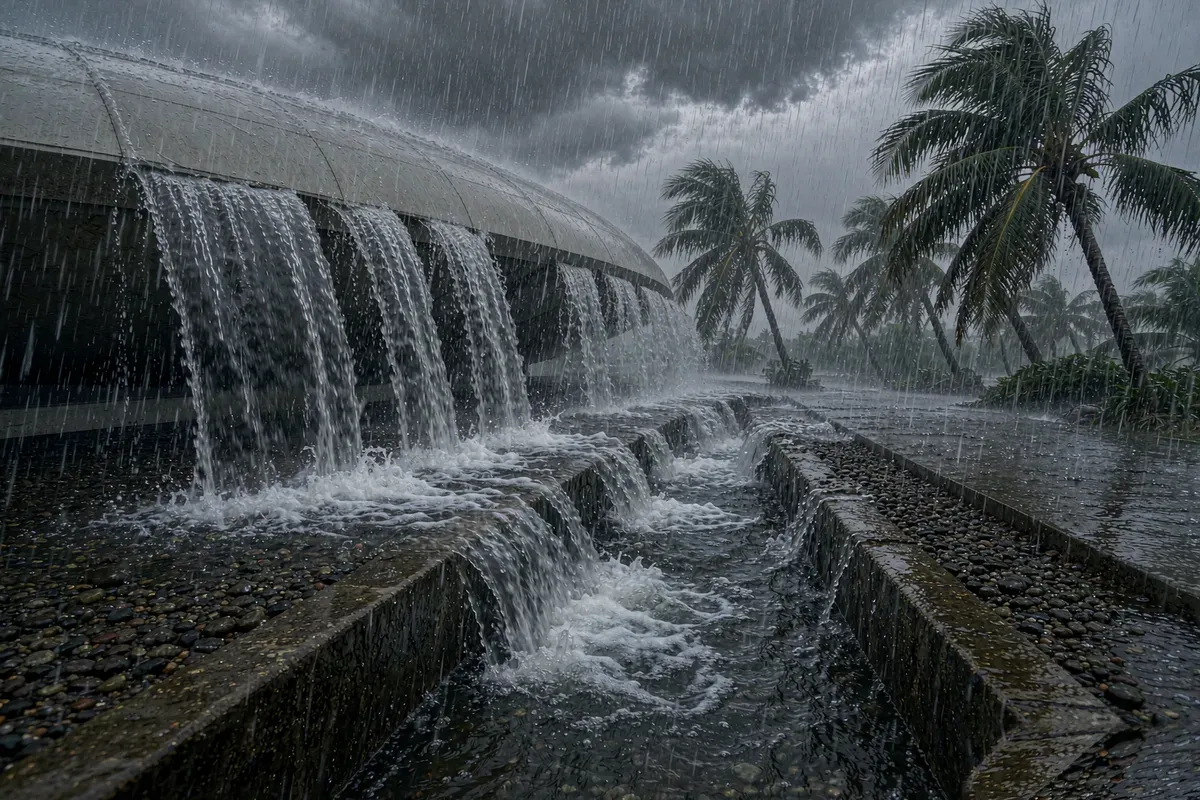
The monsoon delivers intense, sustained rain, not gentle averages. Three details determine whether a unit stays dry: roof drainage capacity and fall, joint and penetration sealing, and site-level drainage that moves water away from the foundation. Roof outlets sized for a temperate climate will be overwhelmed; sealant beads exposed to continuous wetting need the right product and access for renewing. Our dedicated page on rainy-season waterproofing in Thailand goes through each detail.
Site works also carry a schedule risk: earthworks, concrete and crane operations are all weather-sensitive. Build wet-season contingency into the programme and into the contractor's pricing, and consider whether the site can be made accessible in the wet at all.
Cool Season: Comfort in the North
Northern highland sites see genuinely cool nights in the cool season, and a unit specified purely for cooling will feel cold and damp. Insulation continuity, glazing specification and controllable heating change the guest experience here, and the condensation risk shifts from one side of the envelope to the other. This is the second specification line, and it is easy to miss when a project is planned around Bangkok conditions.
Resort Licensing Sits on Top
Operating accommodation in Thailand requires the correct licence for the activity, independent of the building question. Whether a prefabricated unit is classified as a permanent structure, and what that means for building consent, is a determination made locally. Establish it in writing before you order — a unit delivered to a site that cannot legally operate it is the most expensive outcome in this entire list.
Requirements may vary by application, market and applicable regulation. Our page on Thai resort licensing for prefabricated accommodation sets out the sequence of questions to put to your local consultant.
How to Compare Two Quotations
Landed cost is where a cheap quotation stops being cheap. Put both suppliers' offers on the same sheet with the same lines, in the same currency, with the same incoterm and the same scope. Check specifically whether installation, foundation, utility connection, crane, commissioning and spare parts are included or excluded, and whether the quoted configuration is actually the same. A quotation that excludes four lines is not comparable to one that includes them until you add the missing lines at your own local rates.
Our guide to reading a capsule house quotation line by line lists the exclusions to look for and the questions to ask about each.
Phasing, Currency and Contingency
Three items sit outside the line-item budget and still decide whether a Thai project lands on budget. The first is payment phasing: milestone-linked payments tied to verifiable progress keep money and delivery aligned, and they matter more when the project spans several months and more than one currency.
The second is currency exposure. A unit priced in one currency and paid over several months carries exchange risk on the unpaid balance. Establish which currency the quotation is in, whether the rate is fixed for the validity period, and what happens if the rate moves before payment. Where your revenue is in a different currency from your purchase, that exposure is a permanent feature of the model rather than a one-off.
The third is contingency. Site works on tropical ground and wet-season scheduling both carry genuine uncertainty, and a contingency line sized for a temperate project will be too small. Set it against the specific risks your site has identified — soil, access, weather, approvals — rather than as a flat percentage, and keep it visible as its own line rather than distributed across the others, where it becomes impossible to manage.
Building Your Thailand Budget
Send your site location, access conditions, soil information if you have it, intended configuration and target opening date, and we will mark up which lines we can quote and which you must source locally. We do not publish price figures — they depend on configuration, route, market conditions and date, and only your suppliers can establish them. Start from the Galactic A series configurations and then use the contact page to send your site details.
More from the Blog

Capsule Home Cost Guide: What You Really Pay in 2026
EXW, shipping, install and the hidden line items — a transparent breakdown of total landed cost.
Read article →
How to Install a Capsule Home in 3 Days: A Step-by-Step Guide
From site prep to first guest — the exact sequence our install crews follow on every deployment.
Read article →
Real Owners, Real Numbers: Success Stories
How a lakeside resort, a Spanish glamping site and a Singapore dealer hit their targets.
Read stories →Talk to the Factory
Ready to Ride the 2026 Wave?
Get the latest catalog, pricing tiers and a layout sketch for your land — straight from the engineering team.