Capsule House Sabah and Sarawak Delivery: Ports
Capsule house delivery to Sabah and Sarawak: why East Malaysia rates as a separate leg, port selection, river water levels, estate roads and entry paperwork.

Delivering a volumetric unit to Sabah or Sarawak is not the same job as delivering to Selangor, and it is priced as a separate leg for a reason. East Malaysia moves through different ports, on different vessels, under additional entry formalities, and then over roads that were not built for twelve-metre loads. This page covers that last phase. The Peninsular side of the route is covered on our Port Klang shipping page, and the overall Malaysian market picture sits on our capsule house Malaysia page.
Why Carriers Rate East Malaysia as a Separate Leg
Most liner services treat Sabah and Sarawak as a distinct destination rather than a domestic extension of a Peninsular call. The consequences show up in three places.
- Frequency. Direct sailings into Kota Kinabalu, Bintulu, Sibu or Kuching are fewer than into Port Klang or Tanjung Pelepas, so schedule risk is real and should be planned as buffer, not absorbed silently.
- Transshipment. Where there is no direct service, cargo moves through a hub and changes vessel. Every change of vessel is a second lift, another handling cycle and another opportunity for damage.
- Feeder vessel geometry. Smaller vessels mean tighter constraints on unit length, weight and how the load can be lashed. A module that fits comfortably on a mainline ship may not fit the feeder.
Ask the carrier two questions early: is this quoted as a through bill of lading to the final port, and how many lifts does the unit see before it reaches Sabah or Sarawak soil. The answer usually explains the difference between two quotations far better than the freight number does.
Choosing the Port by Site, Not by Sailing Schedule
Each East Malaysian port has a different hinterland logic. Rather than ranking ports on frequency alone, work backwards from the site:
- Kota Kinabalu serves the west coast of Sabah reasonably well and connects to inland districts by road.
- Kuching, Sibu and Bintulu each serve different parts of Sarawak, with river systems doing much of the onward work that roads do elsewhere.
- Where the site is upriver, the port choice is dictated by river draft, water level and the availability of suitable barges and landing points.
Confirm berth capability before you fix the shipment: quay length and strength, available craneage or lack of it, draft restrictions, and whether the port has adequate hard standing for a unit to sit if disconnection is delayed. A unit that cannot be landed because there is nowhere to put it accrues demurrage like any other box.
River and Water-Level Windows
Sarawak's river network is genuine infrastructure. It is also seasonal. The practical implications:
- Water level governs draft and therefore what can be carried, and when.
- Barge availability is local and finite; book it as a resource in its own right rather than as an afterthought to the main movement.
- Loading and unloading points need to be physically prepared — a stable landing, sufficient bank reinforcement and space for the haulage vehicle to turn.
- Storms pause the schedule. Plan the movement so a delay of several days does not cascade into a labour standby cost.
Where a project can choose, overland access that avoids a river crossing usually costs less in coordination even when it costs more in kilometres.
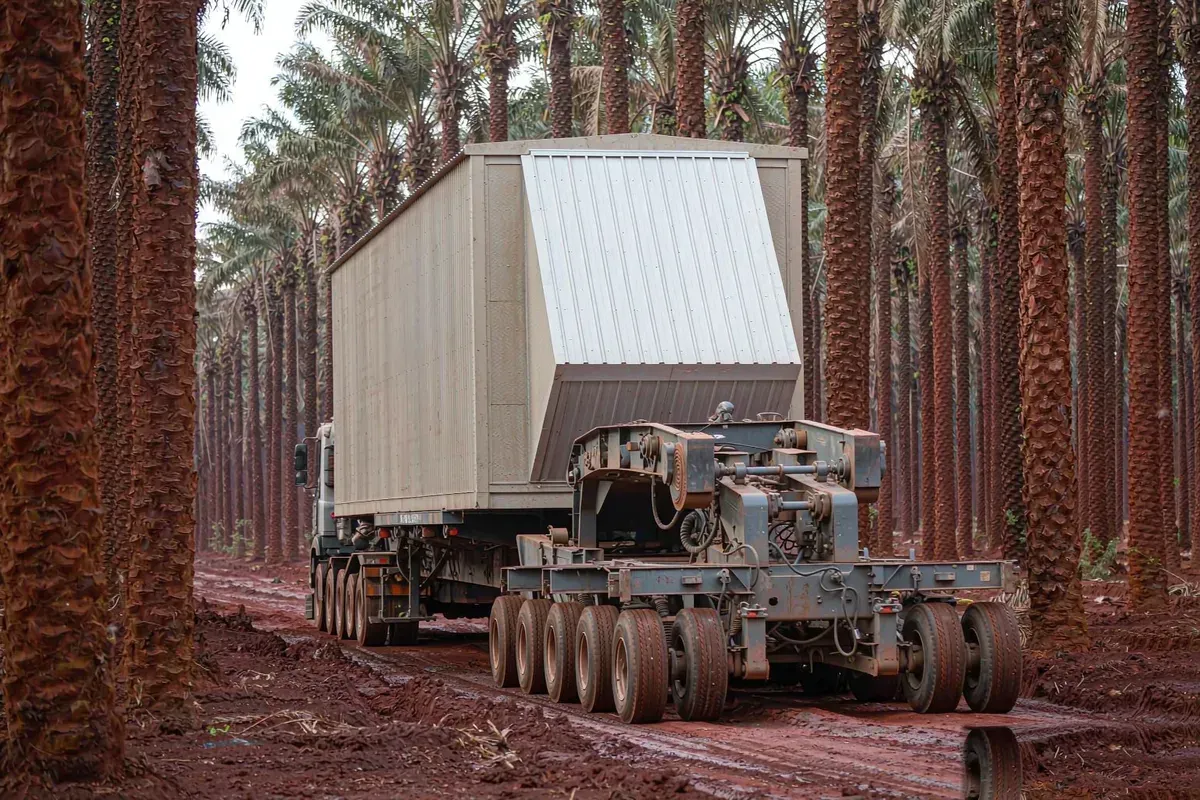
The Last Road: Plantations, Estates and Forest Tracks
Much of the resort and eco-tourism land in East Malaysia sits off roads built for estate traffic. Before committing to a transport plan, get answers to these in writing from someone who has driven the route:
- Minimum carriageway width and the tightest turning radius on the route.
- Bridge and culvert load ratings, particularly small estate structures that were never rated for heavy haulage.
- Overhead clearance including palms, cables and any estate infrastructure.
- Surface condition in wet season and whether laterite sections become impassable after sustained rain.
- Whether any part of the route crosses land where access must be negotiated with an estate manager or a community.
Where the answer is uncertain, route survey before shipping. A physical survey by the haulage contractor costs a fraction of a recovery operation, and it converts an argument about whose fault it is into a documented engineering problem.

Cranes, Crews and Tool Availability
Peninsular Malaysia has deep equipment pools. East Malaysia does not always, and importing equipment across the same boundary adds cost and paperwork. Three questions determine the shape of the installation plan:
- What is the largest available crane within reasonable haul distance of the site, and what is its mobilisation cost?
- Does the site have enough bearing capacity for outrigger loads, or do you need ground preparation or mats?
- Who supplies rigging, tag lines, and signalers — your team, the Malaysian contractor, or a combination, with which insurance?
Apportioning installation scope is discussed generally on our foundation cost page and our utility connection page. In East Malaysia the additional consideration is simply availability: what can be sourced locally, and what has to travel.
Entry Formalities and Seasonal Timing
Moving people and tools into Sabah and Sarawak involves documentation that does not apply within the Peninsula. Crews arriving from outside Malaysia need appropriate work authorisation; specialist tools and equipment crossing the boundary may need temporary import treatment. Confirm current practice with your freight forwarder and the relevant authority before travel, because the cost of an error is a stranded team and a delayed install. Requirements may vary by application, market and applicable standard.
Timing matters too. Monsoon season affects both the sea leg and the road leg, and it affects the laterite sections most. Allowances for weather delay should be written into the programme explicitly. For how vehicles cope mechanically and electrically with sustained monsoon conditions, see our Malaysia monsoon page.
Paperwork Sequence for an East Malaysia Move
- Site access survey: road, river, or both, with photographs and measurements.
- Port and berth confirmation from the carrier and the port.
- Transport plan agreed with a haulier who has run East Malaysian routes.
- Approvals in place for the unit as a structure, coordinated with the local authority submission process described on our Malaysia permit page.
- Crew and tool documentation arranged before anyone flies.
- Weather window chosen, with a fallback week held in reserve.
- Crane and rigging mobilised, ground bearing confirmed.
Each of those steps has a lead time. Running them in parallel rather than in sequence is what turns an eight-week East Malaysia delivery into a five-week one.
Planning Checklist
| Item | Peninsular assumption | East Malaysia reality |
|---|---|---|
| Port call | Direct, frequent | Less frequent, often transshipped |
| Onward transport | Highway network | Estate roads, river systems, or both |
| Crane pool | Deep and competitive | Thinner; mobilisation cost material |
| Crew movement | Domestic travel | Additional entry documentation |
| Weather risk | Monsoon affects some routes | Monsoon affects sea, river and unpaved road |
If you have a site in Sabah or Sarawak and want a realistic sequence rather than an optimistic one, send us the district, the access description and photographs of the final approach. Start from our contact page.
More from the Blog

Capsule Home Cost Guide: What You Really Pay in 2026
EXW, shipping, install and the hidden line items — a transparent breakdown of total landed cost.
Read article →
How to Install a Capsule Home in 3 Days: A Step-by-Step Guide
From site prep to first guest — the exact sequence our install crews follow on every deployment.
Read article →
Real Owners, Real Numbers: Success Stories
How a lakeside resort, a Spanish glamping site and a Singapore dealer hit their targets.
Read stories →Talk to the Factory
Ready to Ride the 2026 Wave?
Get the latest catalog, pricing tiers and a layout sketch for your land — straight from the engineering team.