Capsule House Philippines Power Supply Planning
Plan capsule house power in the Philippines: essential load split, generator sizing, brownout ride-through, coastal earthing and what belongs in an enquiry.
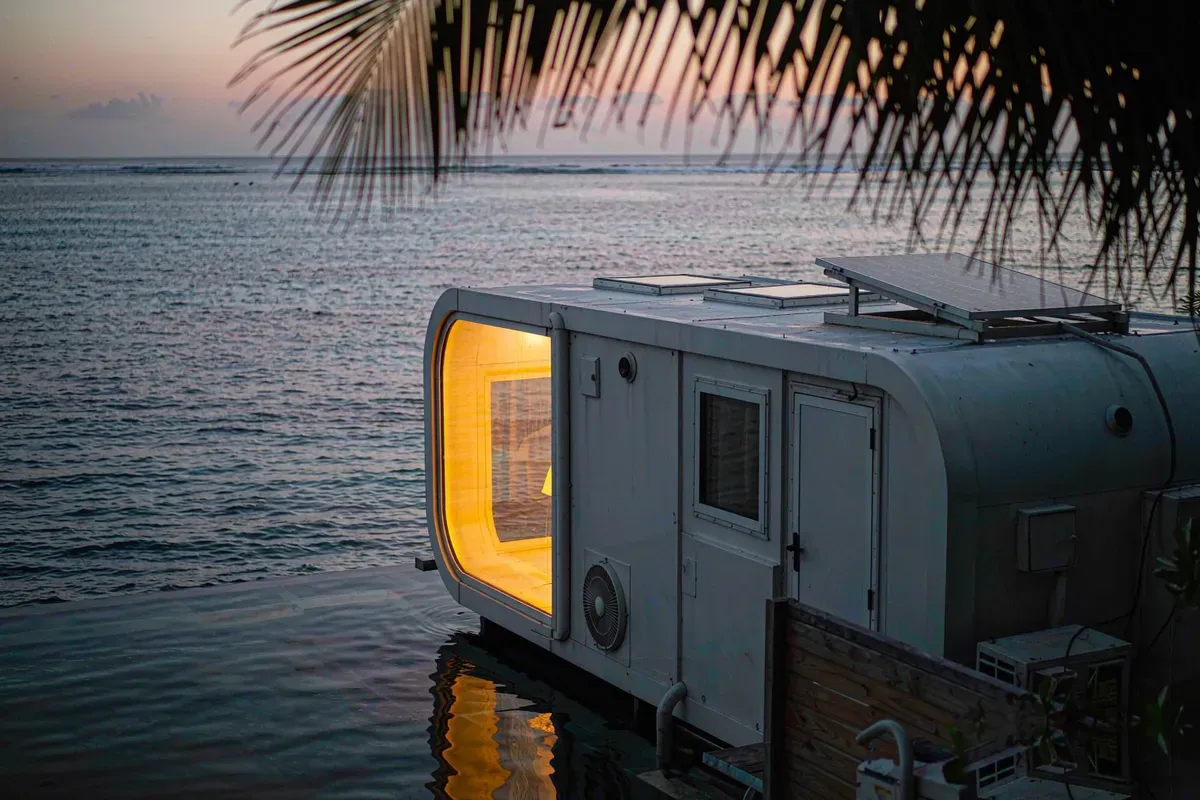
Power is the utility that most often decides whether a Philippine capsule house project feels effortless or permanently improvised. On the main grids of Luzon, Visayas and Mindanao the supply is generally 230 V at 60 Hz, but the binding constraint on an island or coastal site is rarely the nominal voltage — it is how many hours a day that voltage is actually present, and what happens to the cooling load when it is not. This page covers electricity only: supply options, generator sizing, ride-through and protection. Water, wastewater and the delivery route are covered in capsule house water supply in the Philippines, and the country-level context sits in the capsule house Philippines pillar.
Start with the load, not the generator
Every downstream decision — inverter size, battery bank, generator rating, cable section, earthing arrangement — follows from one number: the simultaneous running load of the unit at its worst realistic moment. On a tropical site that moment is usually late afternoon, when air conditioning, a fridge, lighting and a water pump are all running while the sun output is dropping.
Build the figure as a list rather than a guess. Write down each appliance, its running watts, its starting surge if it has a motor, and how many hours per day it genuinely runs. Air conditioning dominates. A compressor that cycles rather than runs continuously has a duty cycle well below 100%, and sizing a generator on nameplate watts alone produces an oversized, under-loaded machine that glazes its cylinders and consumes fuel poorly. The load planning method is set out in more detail in capsule house electrical load planning.
Separate the load into two groups before anything is specified. The essential group — lighting, fridge, communications, water pump, and at least one fan — must survive an outage. The comfort group — full air conditioning, washing machine, outdoor lighting, entertainment — can shed. Once the split is explicit, the battery bank can be sized against the essential group alone, which usually reduces the storage requirement substantially.
Three supply options, and what each one actually buys you
| Option | Best suited to | What it does not solve |
|---|---|---|
| Grid connection only | Sites inside a barangay or subdivision with an existing service drop nearby | Outage duration and voltage sag; brownouts are a planning input, not an exception |
| Grid plus generator | Most resort and staff sites where occupancy must continue through an outage | Fuel logistics, noise window, and maintenance discipline between runs |
| Solar plus battery, generator as backup | Remote islands and off-grid sites where fuel delivery is slow or seasonal | Air-conditioning load at night unless the battery bank is deliberately sized for it |
On most island projects the answer is a combination rather than a choice. Solar covers the daytime base load and charges the battery, the battery carries the essential group through the evening and through short outages, and a generator covers multi-day weather events and the rare heavy load. The cost side of that decision is treated separately in capsule house off-grid upgrade cost.
Generator sizing and the fuel question
Rate the generator against the essential group plus one large motor starting, not against the whole nameplate total. A unit running at 30% load for most of its life will need more maintenance than one running at 60–70%, and the fuel consumed per kilowatt-hour rises as load falls. Ask the supplier for the fuel consumption curve at 25%, 50%, 75% and 100% load, then work backwards from how many litres you can physically store and resupply on the island.
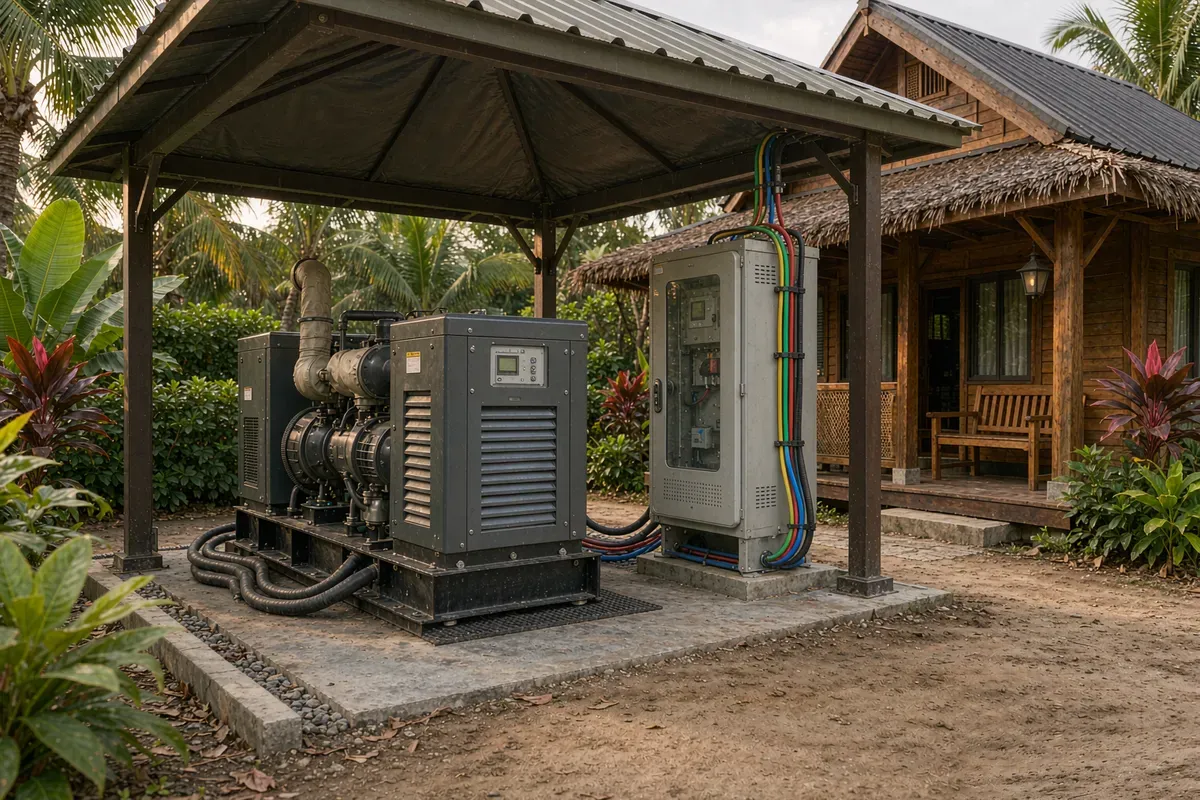
Fuel logistics deserves its own line in the operating plan. On a small island, a drum of diesel is a boat trip, a landing and a manual carry, and each of those steps has a weather window. Sites that run out of fuel in the second week of a monsoon spell are not suffering an electrical failure; they are suffering a logistics failure that happened to present as one. Define the reorder point in litres and in days of autonomy, not in "when it looks low".
Brownout ride-through and protection
Repeated sag and rapid restoration is harder on equipment than a clean outage. Two protections do most of the work. An automatic transfer switch moves the load to the generator or inverter without the occupants doing anything, and a surge protective device at the main board absorbs the transient that accompanies restoration. Undervoltage and overvoltage protection on the incoming supply prevents an air-conditioning compressor from stalling against a low-voltage supply, which is a common cause of premature compressor failure on island grids.
Ask your designer to specify the protection by function rather than by catalogue number, and to state in the drawings where each device sits: at the utility interface, at the sub-board, or at the equipment. Then confirm the arrangement with the electrician who will actually sign it off. Requirements may vary by application, market and applicable standard.
Earthing, bonding and the salt-air problem
Coastal and island sites combine humid salt-laden air with sandy, often rocky ground, and both work against a durable earth. Sandy soil has poor and seasonally variable resistivity, so an earth electrode that measures acceptably in the dry season may not do so after heavy rain or, conversely, may drift the other way in prolonged dry weather. The practical response is not a single large electrode but a measured arrangement: more than one electrode, driven to a documented depth, bonded together and re-tested after the first wet season.
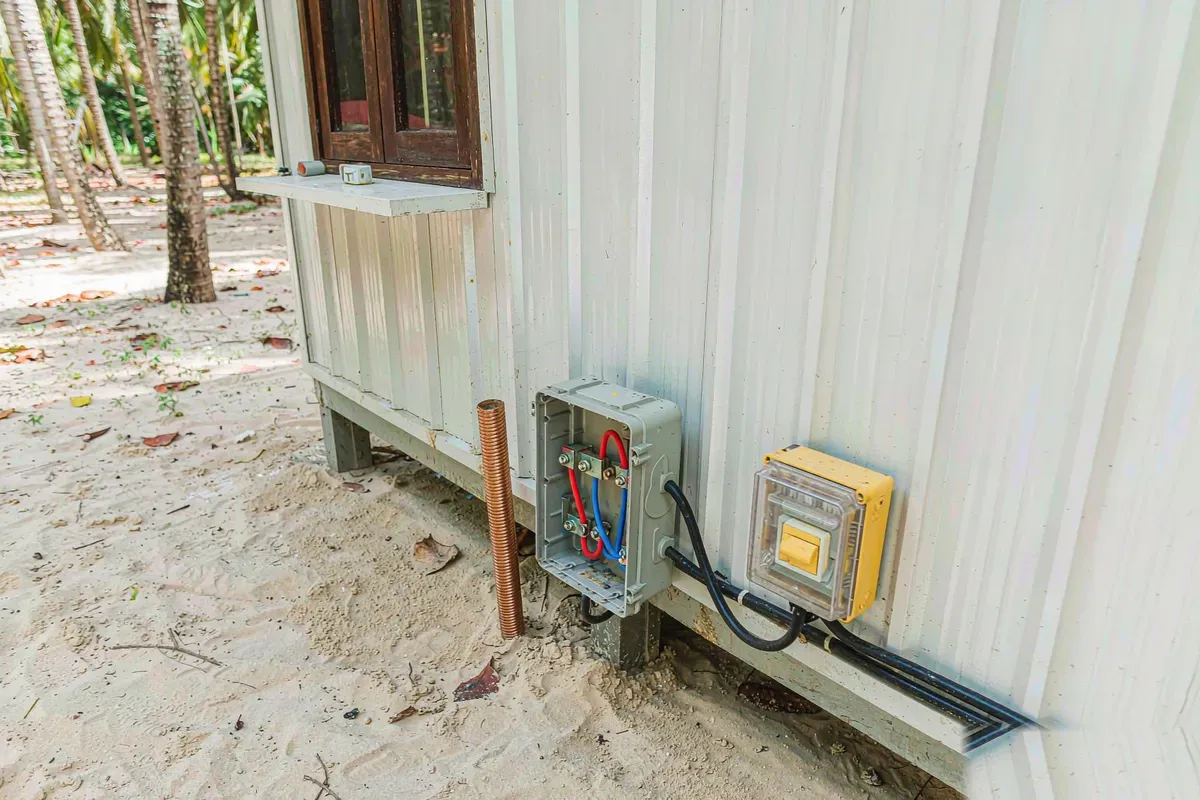
Bonding is the partner issue. Any metal that a guest can touch and that could become live — the deck frame, the handrail, the air-conditioning outdoor unit, the generator canopy — needs to be bonded back to the same earth reference. On a unit with a large glazed area and an aluminium frame, this is a specification item, not an afterthought. Specify marine-grade fittings and stainless fixings where the exposure is severe, and record the torque and the test result at handover rather than assuming it was done.
What to put in the enquiry
- Site supply: nominal voltage and frequency, single or three phase, and the nearest available connection point with a distance.
- Outage profile: typical duration and frequency, in hours per week, based on operator experience rather than a published average.
- Load list: every appliance with running watts and starting surge, split into essential and sheddable groups.
- Preference on ride-through: automatic transfer to generator, battery-backed essential circuit, or both.
- Ground conditions at the electrode location: sand, rock, or fill, and whether a wet-season re-test is feasible.
- Exposure: distance from the shoreline and whether the site is subject to direct salt spray.
Those six lines let a factory and a local electrician quote against the same problem. Without them, two quotes are not comparable even if they are for the same unit. Budget context is covered in capsule house price in the Philippines, and the site-side services picture in capsule house water supply in the Philippines.
Commissioning and the first ninety days
Do not treat energisation as the finish line. In the first ninety days, record three things: the voltage at the unit under full load, the number and duration of transfer events, and the measured earth resistance before and after the first heavy rain. Those three records tell you whether the design assumptions held. Where they did not, the adjustment is usually small — a larger cable section, an extra electrode, a revised generator start delay — and far cheaper than a retrofit discovered a season later.
Keep the record with the handover pack. It is the reference for the next unit on the same site, and it is the evidence a future buyer or insurer will ask for. Requirements may vary by application, market and applicable standard.
More from the Blog

Capsule Home Cost Guide: What You Really Pay in 2026
EXW, shipping, install and the hidden line items — a transparent breakdown of total landed cost.
Read article →
How to Install a Capsule Home in 3 Days: A Step-by-Step Guide
From site prep to first guest — the exact sequence our install crews follow on every deployment.
Read article →
Real Owners, Real Numbers: Success Stories
How a lakeside resort, a Spanish glamping site and a Singapore dealer hit their targets.
Read stories →Talk to the Factory
Ready to Ride the 2026 Wave?
Get the latest catalog, pricing tiers and a layout sketch for your land — straight from the engineering team.