Capsule House Incoterms Buyer Allocation Guide
Capsule house Incoterms for buyers: where risk transfers, who books ocean and inland legs, clearance documents, insurance and contract wording.

In a capsule house order, the trade term you choose decides who books and pays each leg, who handles clearance, and the exact point where the risk of damage to a fully glazed unit passes to the buyer. For freight rates see our shipping cost guide, and for duties see our import duty guide.
Map what the buyer takes on at each common delivery point
Walk the delivery chain and mark that point: the factory gate, a loading depot, the port of loading, alongside the vessel, the port of destination, a terminal, and finally the prepared site. At each point ask four questions. Who loads the unit. Who books and pays the carriage from there. Who holds the risk of loss or damage from that moment. And who arranges the clearance or handling the next step requires. A fully assembled space capsule home is not a small parcel, so the physical handover matters as much as the paperwork.
Under a factory-gate style term, the buyer takes on almost every downstream task: collection, the haul to port, the ocean booking, the inland leg on arrival and the lift onto the support. Under a delivered-to-site style term, the seller carries most of those tasks, but the buyer still owns the site access and the receiving check. Write the answers next to the named place, and check that the quotation describes the same boundary as the contract. A mismatch is a common source of dispute, because the carrier works to whichever document it was given. Confirm the named place with the seller in writing before any carrier is booked.
Clearance tasks are described more generally in the import and customs duties guide; the term decides which side carries them.
Split the ocean leg from the inland legs
A term can place the ocean, or main, carriage with the seller while the inland legs stay with the buyer, or the other way round. The pre-carriage from the factory to the port of loading, the main ocean leg, and the on-carriage from the port of destination to the site are separate contracts even when they appear on one invoice. Ask who contracts the carrier on each leg, who pays that carrier, and who is named on the transport document.
| Leg or task | Factory-gate style term | Delivered-to-site style term |
|---|---|---|
| Pre-carriage to the port of loading | Buyer books and pays | Usually arranged by the seller |
| Main ocean carriage | Buyer books and pays | Usually arranged by the seller |
| Inland leg on arrival | Buyer books and pays | Usually arranged by the seller |
| Loading at origin | Buyer directs | Seller directs |
| Placement on the prepared support | Buyer arranges lifting | Often included, confirm in writing |
Treat the table as a prompt, not a rule. The chosen term and the named place override any general pattern, and the contract is where the split is fixed. Ask a qualified logistics provider to confirm the allocation, and check that each leg has a named party rather than an assumption. Agree who passes the unit from one carrier to the next.
Damage evidence follows the process in the freight damage claims guide, whatever the term says.
Pin down where risk transfers before the glazing moves
Risk transfer and payment allocation are not the same thing, and confusing them is costly for a unit with panoramic glazing. The seller may pay for carriage past a certain point while the risk of damage has already passed to the buyer at an earlier point. If a glazed panel cracks during a lift at the port of loading, the question is not who paid the ocean freight but who held the risk at that moment. Identify the risk point in the contract and, where possible, align it with a step where the buyer can actually inspect the unit. Ask for a condition record at each handover.
Agree who notes damage on the transport document and who notifies the insurer. Where a term places risk with the buyer early, confirm that the buyer's cargo policy starts at that point rather than later. Work with a qualified logistics provider to set the inspection points, and confirm requirements with the authority having jurisdiction for any local filing tied to the delivery. A risk point the buyer cannot observe is a risk point to renegotiate.

Allocate export and import clearance and the documents each side needs
Ask which party handles export clearance at origin and which handles import clearance at destination, and confirm the answer matches the named place. Then list the documents each side needs from the other. For export, the party filing typically needs a commercial invoice, a packing list, a description of the goods and any origin or declaration documents the destination asks for. For import, the receiving party typically needs the transport document, the commercial invoice, the packing list and the declarations its market requires.
Ask who issues each document, who checks it for consistency, and who corrects a mismatch before the unit is held. A unit described differently on the invoice and the packing list can be delayed, and a delay with a fully assembled cabin has knock-on costs for lifting and storage. Request the documents as drafts before the unit ships. Confirm requirements with the authority having jurisdiction for the specific market, and ask a qualified logistics provider to check the set. Do not assume a document used for a previous market will serve a new one. State in the contract which side supplies each document. Agree a deadline for the draft set so neither side works from an old version.
Insurance cost is priced in the freight insurance cost guide and moves with the term you choose.
See how insurance responsibility changes and compare the two practical extremes
Under some terms the seller has no obligation to arrange cover, and the buyer must put its own policy in place from the risk point. Under others the seller arranges a policy, but the buyer should still check the scope, the exclusions and who may claim. Either way, hold a policy that starts when risk passes to you and covers the unit while lifted and staged, not only at sea. Ask the seller to state in writing whether cover is included.
Factory-gate for a buyer with no local team
A factory-gate term gives the buyer control but also the full to-do list. Without a local logistics team, the buyer must appoint an agent for collection, the haul to port, the ocean booking, the inland leg on arrival and the lift. Each handover is a chance for a gap in responsibility. Ask who coordinates the agents and who pays them if the unit waits.
Delivered-to-site for the same buyer
A delivered-to-site term shifts coordination to the seller, which suits a buyer without local staff. It can also hide cost items in the seller's quote, so ask for a breakdown of what is inside that figure. The buyer still owns the access route, the prepared support and the receiving inspection. Turnkey delivery is part of the Haishu offer, but the term decides how far that delivery reaches.
For larger orders, the tender and bid document pack should repeat the term and the named place verbatim.
Put the same wording into the RFQ template so every supplier quotes on the same delivery point.
Name the term and the place precisely, and find the hidden costs
Name the exact location, not a country or a vague region: a specific terminal, a specific port, a specific address. State the applicable rule edition in the contract rather than assuming both sides mean the same one, and have a qualified logistics provider confirm the wording. Put the identical term and named place on the quotation, the order confirmation and the contract.
Cost items a term can bury
Ask for a line-by-line breakdown from both sides, because a term pushes costs into the quote of whoever owns that leg. Check for:
- Terminal handling and short-term storage.
- Inland haulage and waiting time for the carrier.
- Clearance filing and document correction.
- Lifting equipment and the crew to place the unit.
- Insurance gaps between the risk point and cover.
For the wider picture see our capsule house price guide, and for the surrounding agreement see our purchase contract clauses page. These pages cover their own subjects; this section is only about what the term hides.
Receiving and handover
Agree who signs for the unit at the named place, who records its condition, and who raises a claim if damage is found. Confirm requirements with the authority having jurisdiction for any local approval tied to the installation.
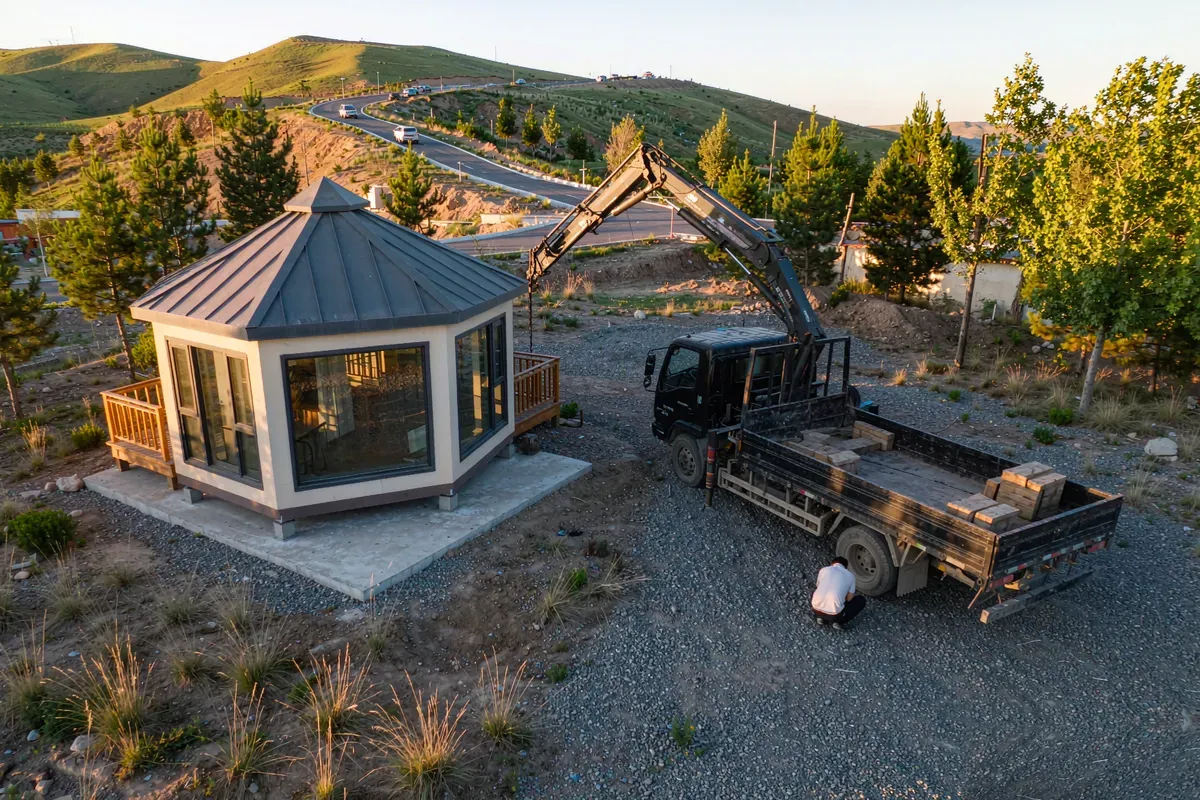
Read every term as a list of tasks with a named place and a risk point, and keep that list aligned across the quotation and the contract. Requirements may vary by application, market and applicable standard.
More from the Blog

Capsule Home Cost Guide: What You Really Pay in 2026
EXW, shipping, install and the hidden line items — a transparent breakdown of total landed cost.
Read article →
How to Install a Capsule Home in 3 Days: A Step-by-Step Guide
From site prep to first guest — the exact sequence our install crews follow on every deployment.
Read article →
Real Owners, Real Numbers: Success Stories
How a lakeside resort, a Spanish glamping site and a Singapore dealer hit their targets.
Read stories →Talk to the Factory
Ready to Ride the 2026 Wave?
Get the latest catalog, pricing tiers and a layout sketch for your land — straight from the engineering team.