Portable vs Capsule House: Siting and Transport
Portable versus capsule house on five criteria: move frequency, access and turning radius, lift method, sealing performance and the approval category.
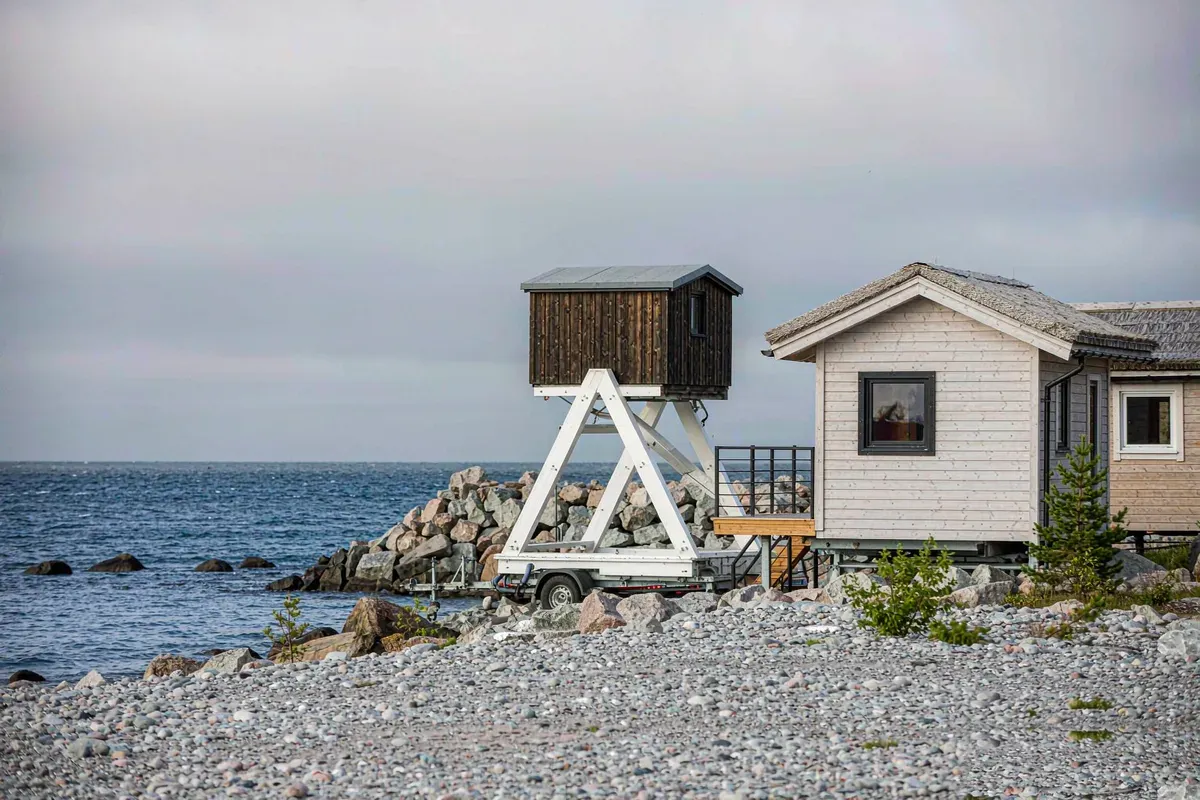
Portable house versus capsule house is not a question of which is better. It is a question of how many times the building will move in its service life, and everything else follows from the answer. A unit designed to be moved repeatedly carries a chassis, lifting points and a structure stiff enough to survive the move; a unit designed to be set once on a prepared substructure can put that weight into the envelope and the interior instead. This page gives selection criteria only. It does not declare a winner, because on a plot that will never be redeveloped the relocatable capability is weight and cost spent on something that will not be used, and on a lease that expires in five years it is the whole point. Definitions of both types are on our space capsule house overview; the folding variants are covered under expandable houses; the smaller fixed garden units under garden pods. Setting and lifting cost drivers are treated separately on our installation cost page.
Criterion One: How Often Will It Move
This is the first question and it changes the specification more than any other. Three realistic patterns cover almost every case:
- Move once, then stay. Delivered to a plot and set permanently. The transport is an event, not a recurring requirement. Here the relocatable features are only needed to survive the first move plus any future relocation that may never happen.
- Move occasionally. Seasonally, or on lease renewal, or as a fleet unit rotated between sites. The structure has to accept repeated lifting without cumulative damage, which means engineered lifting points, a chassis or base frame that distributes the lift load, and connections that can be broken and remade.
- Move often, by design. Events, touring operations, or a rental fleet redeployed between locations. Here the unit is closer to equipment than to a building, and the specification is driven by the number of cycles it must survive rather than by its comfort when standing still.
Be honest about which pattern applies. Buyers frequently specify for the second or third pattern on a site that will in fact never move the building, and pay for capability they never use. The reverse error — buying a fixed unit for a genuinely mobile operation — is worse, because it usually shows up as damage on the first relocation.
Criterion Two: Access, Turning Radius and Ground Pressure
A unit can be technically movable and practically immovable, because the constraint is usually the route rather than the building.
- Approach width and overhead clearance. Gate openings, lane widths, overhanging trees and structures, and any bridge or culvert on the route. Measure the narrowest point, not the average.
- Turning radius. The combination of tractor and trailer needs more room than the tractor alone. A tight bend on a gravel track is the most common single reason a delivery fails on the first attempt.
- Ground pressure and surface. Soft ground, sand and recently filled areas will not carry a loaded low-loader or a crane outrigger without preparation. Where the surface is marginal, mats or a prepared platform are required, and that is site work.
- Gradient. Steep or uneven approaches change the equipment needed and sometimes the method entirely.
Survey the route before ordering, not before delivery. A route survey is cheap and the alternative is a unit that has to be returned or stored at the buyer's cost while a solution is found. On island or remote destinations the route survey has to include the port handling equipment and the inland leg, not just the final approach.

Criterion Three: How It Is Lifted and Set
The lift method is partly a property of the unit and partly a property of the site, and the two have to be reconciled.
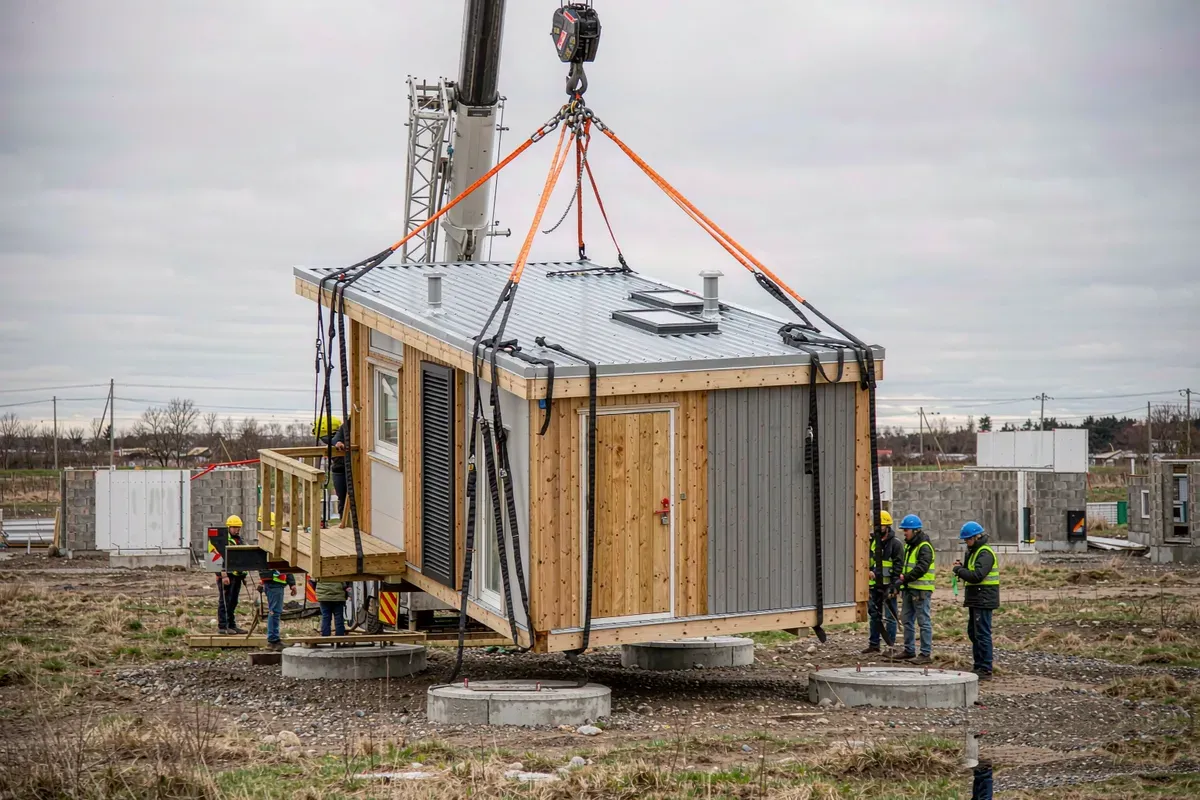
- Mobile crane. The most common method for a set-once unit. Capacity is determined by radius as well as weight, so a unit that must be placed over an obstacle or at a distance needs a larger machine than its weight suggests.
- Self-loading or hydraulic leg systems. Reduce or remove the crane requirement and suit sites where bringing a crane in is expensive or impossible. They add weight and cost to the unit and require an operator who knows the system.
- Skidding or jacking into position. Used where overhead clearance rules out a lift, or where the unit must go under an obstruction. Slower, and it needs a prepared level path.
- Setting onto the substructure. Whichever method, the final set onto piers, pads or a slab is a separate operation from the lift and is where alignment is achieved.
Ask which method the unit is designed for and confirm that it is available locally at a reasonable cost. A unit that requires a crane size only available from the nearest large city will cost more to place than a slightly heavier unit that a local machine can handle.
Criterion Four: Sealing Performance of a Relocatable Shell
A shell that is built to be moved has more joints than one that is not, and every joint is a place where air, water and dust can enter. This is the trade-off at the centre of the comparison.
- Folding and demountable joints give transport efficiency and create sealing obligations. The seal has to be designed for the number of cycles expected, with the replacement interval stated rather than assumed.
- A fixed monocoque shell has fewer joints and therefore fewer places to fail, at the cost of using more transport volume for the same floor area.
- Service connections differ for the same reason. A relocatable unit needs connections that can be broken and remade without damage, which means accessible, protected, standardised terminations rather than buried permanent ones.
Whatever the type, the sealing question should be asked as a maintenance question: which seals exist, what is the stated service life, how are they inspected, and are replacements available locally. A unit with a sophisticated sealing system and no local supply of replacement gaskets will fail earlier in practice than a simpler one that can be maintained. Where a supplier states a performance level for air or water ingress, request the test report and confirm it with the issuing body. Requirements may vary by application, market and applicable standard.
Criterion Five: How Each Is Treated for Approval
The approval treatment of a relocatable unit and a fixed unit diverges, and the direction of the divergence depends on the market.
- Fixed on a permanent substructure is generally reviewed as a building, with the substructure design and the inspection hold points that implies.
- Retaining a chassis and running gear may place the unit in a different category altogether, sometimes closer to a vehicle or a movable structure, with a different authority and a different set of requirements.
- Temporary or seasonal use may be permitted under a different provision again, often with a time limit and conditions attached.
- Services and connection are frequently reviewed separately from the structure, and a temporary structure with permanent service connections can be the hardest combination to get through.
Establish the category with the authority having jurisdiction before specifying, because the category determines which requirements apply, and it is difficult to change after the unit has been built. Requirements may vary by application, market and applicable standard.
A Selection Checklist
Answer these in order, in writing, before comparing quotations:
- How many times will the unit move in ten years, and how far each time?
- Has the route been surveyed to the narrowest point, and is the ground along it capable of carrying the equipment?
- Which lift method does the unit require, and is that equipment available locally at a known cost?
- Which category does the authority having jurisdiction place the unit in, and what does that require?
- Which seals exist, what is their stated service life, and are replacements stocked locally?
- What is the substructure, and who is the licensed engineer designing it for this ground?
Where the answers point to a relocatable unit, look at the chassis, the lifting points and the seal design first and the interior finish second. Where they point to a fixed unit, the transport features matter only once and the envelope and interior matter for the whole service life. That is the whole of the comparison.
More from the Blog

Capsule Home Cost Guide: What You Really Pay in 2026
EXW, shipping, install and the hidden line items — a transparent breakdown of total landed cost.
Read article →
How to Install a Capsule Home in 3 Days: A Step-by-Step Guide
From site prep to first guest — the exact sequence our install crews follow on every deployment.
Read article →
Real Owners, Real Numbers: Success Stories
How a lakeside resort, a Spanish glamping site and a Singapore dealer hit their targets.
Read stories →Talk to the Factory
Ready to Ride the 2026 Wave?
Get the latest catalog, pricing tiers and a layout sketch for your land — straight from the engineering team.