Expandable Prefab Houses Guide for Resort Projects
How expandable prefab houses work for resort projects: transport envelope versus deployed area, on-site deployment, wind and sealing questions, and maintenance.
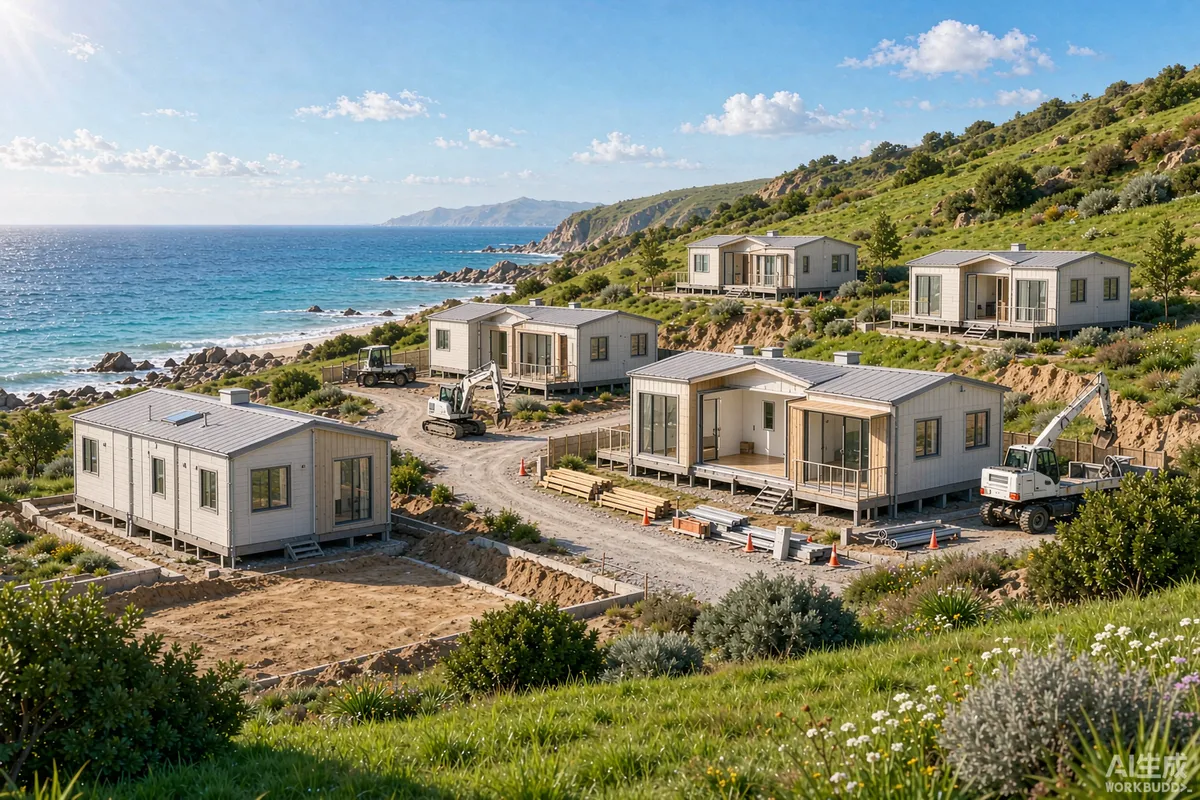
An expandable prefab house is built to travel in a reduced envelope and deploy on site into a larger floor area. For a resort project the proposition is straightforward: more usable room per unit of shipping volume, which means more keys per shipment and more keys per container of freight. The cost of that is equally straightforward: a deployment step on site, and a moving joint that has to be engineered, sealed and maintained. This page is the reference for the type — what "expandable" means in practice, where the trade favours it, where it does not, and what to ask before ordering. The mechanism itself is examined in how the folding mechanism works and what to check. Requirements may vary by application, market and applicable standard.
What "Expandable" Means in Practice
Three families of mechanism are in use, and they are not equivalent in cost, complexity or durability.
- Fold-out wings. Side sections hinge down or out from the transport core, typically forming additional floor area once deployed. The most common type, and the one where the sealing of the moving joint is the critical detail.
- Sliding or telescopic sections. One volume moves out of another, usually on a rail or roller system. Good enclosure when closed; the rail system needs to tolerate dirt and be maintainable.
- Hinged or folding end sections. Similar principle applied to a smaller area, frequently used to create a covered terrace or a second room.
What they share is the trade: the deployed area is larger than the transport envelope, and the difference is created on site by a mechanism. The useful number is therefore not the floor area alone, but the ratio between the deployed area and the packed volume — because that ratio is what the freight and the clearance are charged against during transport, and what the guest experiences during use.
The Numbers That Matter
Ask every supplier for the same four figures and put them side by side, because they determine the whole logistics case.
| Figure | What it determines |
|---|---|
| Packed external dimensions and gross weight | Freight mode, route feasibility, number of units per vessel or convoy |
| Deployed external dimensions | Site layout, setbacks, separation distances, crane placement |
| Deployed internal floor area | What you are actually selling per key |
| Deployment time and crew requirement | Site programme, labour cost, and how many units can be turned out per day |
The commercial comparison should then be made as cost per deployed square metre delivered to the site, not as cost per unit. A unit that ships two to a container and deploys to a large area can beat a cheaper unit that ships one to a flat rack and deploys to a smaller one — and the freight difference is often larger than the product difference.
Deployment on Site: Crew, Time and Equipment
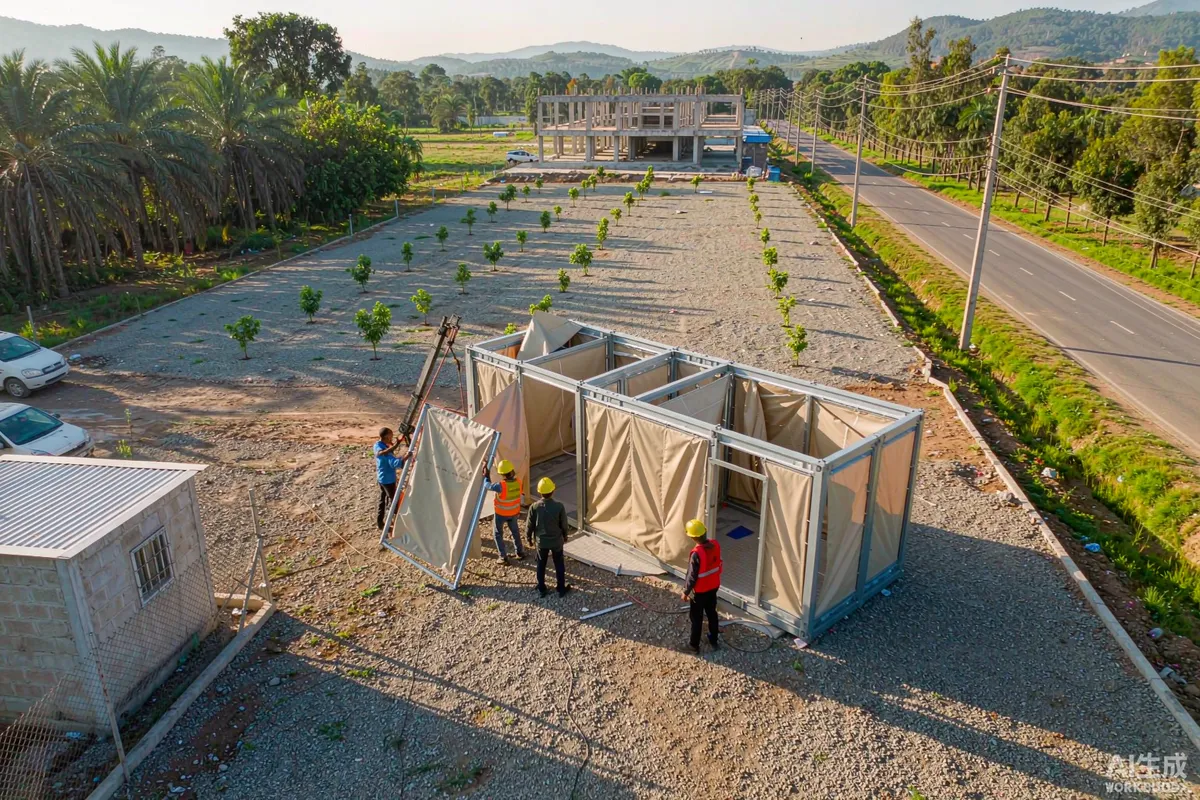
Deployment is a construction activity and should be planned as one. The inputs are a level pad within the tolerance the supplier specifies, the lifting plant the mechanism requires, and a crew that has done it before.
- Pad readiness. A mechanism that has to deploy against a pad that is out of level will bind, and a bound mechanism is both a safety and a warranty problem. Verify the pad before the unit arrives.
- Plant. Whether the deployment needs a crane, a telehandler, or only a crew and a forklift determines both the cost and which sites are feasible.
- Crew and sequence. How many people, for how long, and how many cycles a trained crew completes per day. That figure determines how many units can realistically be turned out during the delivery window.
- Commissioning after deployment. Seals, services connections, levelling checks, and a function test of the mechanism with the result recorded.
- Training. Your maintenance team should be trained on the mechanism before the supplier's crew leaves, not after.
Ask the supplier to state the deployment requirement in writing, including the number of cycles the mechanism is designed for. Where a supplier quotes cycle-test data, ask for the test report and verify it; we do not publish performance claims on behalf of suppliers.
Where the Type Beats a Fixed-Volume Unit
- Poor road access. A smaller transport envelope passes gates, bridges and narrow tracks that a wide finished unit cannot.
- Remote or island sites. Fewer and smaller shipments reduce exposure to freight volatility and to limited sailings.
- Projects that need keys quickly. More units per shipment shortens the delivery programme for a phased opening.
- Seasonal or redeployable installations. A unit that can be closed and moved is an asset that can follow demand.
- Sites where the crane size is constrained. A smaller, lighter transport unit can sometimes be handled by plant already on site.
Where It Is the Wrong Choice
Being explicit about this saves more money than any other part of the evaluation.
- Frequent relocation. Every cycle is wear. A unit intended to move every few weeks should be specified as a mobile product, which is a different design brief.
- High-wind exposure without engineered hold-down. A large deployed surface with a moving joint needs the wind load path designed by a local engineer for the site, and the tie-down built to that design.
- Sites without a level pad. If preparing a level pad is disproportionately expensive, the deployment advantage is spent on the foundation.
- Very dusty or icing conditions. Fine sand and ice both attack moving joints and seals; specify accordingly or choose a fixed-volume unit.
- Markets where the approval route is slow. The speed advantage is only realised if the permits keep pace with the delivery.
Structural and Envelope Questions to Ask
The moving joint is the engineering heart of the type, and the questions cluster around it.
- Wind load and hold-down. What design wind was the deployed structure calculated for, and what is the anchorage detail? This must be reconciled with the local engineer's design for your site.
- Sealing at the joint. How is the moving joint sealed against water and air, what is the seal material, and what is the replacement interval and method?
- Thermal continuity. A joint is a potential thermal bridge and a condensation risk. Ask how insulation is carried across it.
- Water management. Where does water that reaches the joint go? The drainage path should be on the drawing rather than assumed.
- Cycle life and testing. How many deployment cycles is the mechanism designed for, and is there test data to support the figure?
- Failure mode. If the mechanism fails in the deployed state, can the unit be occupied safely, and can it be closed manually?
- Electrical and plumbing across the joint. Where services cross a moving joint, ask how the connection is made and protected, and how it is accessed for repair.

Maintenance and Warranty in Operation
Over a ten-year operating life, the mechanism will be serviced more often than the structure is touched. Plan for it explicitly.
- A written schedule. Lubrication, seal inspection, fastener checks and a function test, at stated intervals, with the intervals in the handover manual.
- Consumables and spares. Seals, bearings, rollers or slides, and any proprietary part. Order them with the units, because shipping a single seal later costs more than the seal.
- Warranty scope in writing. What is covered, for how long, who decides whether a failure is a defect or wear, and who pays the freight on a replacement part.
- Record keeping. A log of cycles and services, which supports both warranty claims and resale value.
- Trained staff. At least two people trained by the supplier before handover.
How to Write It Into an Enquiry
Add these lines to the technical section of your RFQ and require a stated value for each: packed dimensions and weight; deployed dimensions; deployed floor area; deployment time and crew; design wind and hold-down detail; joint sealing method and seal replacement interval; cycle life with supporting test data; service-crossing method; warranty scope and duration; spare parts list supplied with the order. Requiring values rather than assurances is what makes the responses comparable — the full structure is in the capsule house RFQ template, and the manufacturer evaluation side in the supplier evaluation guide.
Current configurations, including expandable models, are on the product pages. For a project quantity, send the site conditions, the number of keys and the access constraints. Requirements may vary by application, market and applicable standard.
More from the Blog

Capsule Home Cost Guide: What You Really Pay in 2026
EXW, shipping, install and the hidden line items — a transparent breakdown of total landed cost.
Read article →
How to Install a Capsule Home in 3 Days: A Step-by-Step Guide
From site prep to first guest — the exact sequence our install crews follow on every deployment.
Read article →
Real Owners, Real Numbers: Success Stories
How a lakeside resort, a Spanish glamping site and a Singapore dealer hit their targets.
Read stories →Talk to the Factory
Ready to Ride the 2026 Wave?
Get the latest catalog, pricing tiers and a layout sketch for your land — straight from the engineering team.