Expandable Prefab Houses: How the Folding Mechanism Works and What to Check
An expandable prefab house ships narrow and unfolds wide. Here is what the mechanism actually does, which parts wear, and what to verify before you order.

An expandable prefab house does one thing a fixed-volume unit cannot: it ships narrow and arrives wide. Wall, floor and sometimes roof sections fold inward so the module travels inside a standard shipping container, then unfold on site to open up substantially more usable floor area. That mechanism is the single most important thing to understand before you buy, because it is the only part of the building that both moves and has to keep weather out at the same time.
Strip away the marketing language and the mechanism has three jobs. It has to carry load when deployed, it has to seal wind and rain out at the moving joints, and it has to repeat the fold-and-unfold cycle without losing alignment. Every check that matters on a purchase visit - hinges, rails, seals, locks, drainage - follows from those three jobs.
What Actually Moves
Folding wall and roof panels
In most expandable designs the side walls are hinged at the floor line and fold inward to lie flat against the floor or against the fixed end walls during transport. Some designs fold the roof section as well; some keep the roof fixed and only move the walls. The distinction matters operationally: a design with fewer moving planes generally has fewer joints to seal, but it also gives up some of the width gain.
Slide rails and floor extension
Where a floor section extends outward, it is usually carried on slide rails or rollers rather than simply swinging on a hinge. Rails carry the load along their length instead of concentrating it at a pivot, which is why they are used for the heavier floor panels. The trade-off is that rails need to stay clean and aligned. Grit, gravel or a bent rail turns a smooth two-person deployment into a fight.
The practical consequence for a buyer: the deployment path has to be kept clean on site. The few metres in front of an expandable unit are working space, not landscaping.
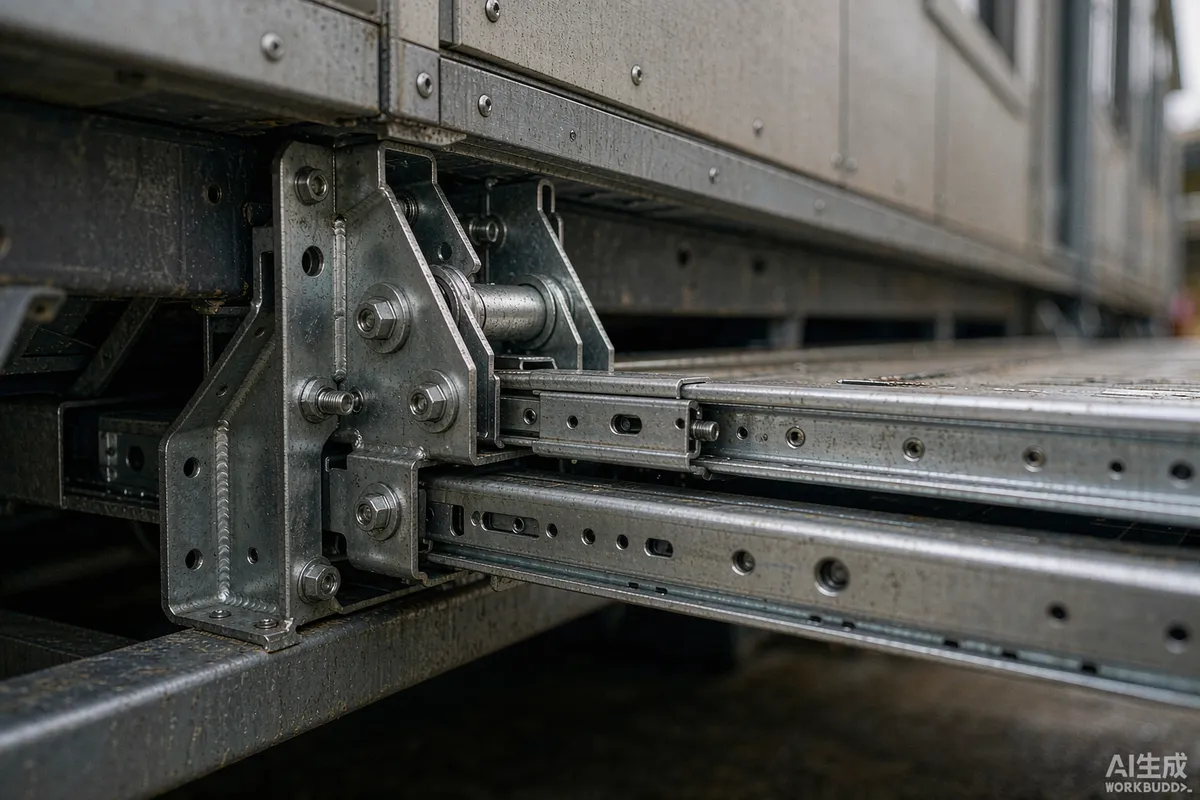
The Parts That Wear
Everything in this list is a normal wearing part. None of it is a defect - but all of it should be specified, documented and available as a spare before you need it.
- Hinge pins and bushes - the highest-load wear points, and the ones most likely to develop play over time.
- Slide rails and rollers - sensitive to grit, impact damage and misalignment.
- Seals and gaskets - compression seals take a permanent set over years; they are consumable, not lifetime parts.
- Locking bolts and catches - these hold the deployed structure rigid and are safety-relevant, not cosmetic.
- Cable and hose loops - any service crossing a moving joint needs a loop long enough to flex without strain.
- Sealant beads at joints - movement cracks rigid sealant eventually; inspect annually.
Sealing the Moving Joints
A moving joint cannot be sealed the way a fixed wall is sealed. It needs a joint detail that tolerates movement and a drainage strategy that accepts that some water will get past the outer line.
| Joint element | Job | What to confirm |
|---|---|---|
| Outer compression seal | Stops bulk water and wind | Continuous run, no gaps at corners; replaceable profile |
| Inner air seal | Stops draughts and air leakage | Seats evenly when locked; not painted over |
| Drip channel or gutter | Carries away water that gets past the outer seal | Falls to a free outlet; not blocked by the mechanism |
| Lock-down pressure | Compresses the seals evenly | Locks fully home without excessive force |
| Flexible sealant bead | Backs up the mechanical seals | Stays flexible; inspected and renewed on a schedule |
Two seals with a drained cavity between them will always outperform one seal that has to do everything. If a design relies on a single line of defence at a moving joint, ask why.
Deploying on Site: The Sequence That Avoids Damage
Most deployment damage is caused by rushing, by deploying on ground that is not yet level, or by forcing a mechanism that has not been released properly.
- Set the unit on a prepared, level base first. A mechanism deployed on a twisted base will bind.
- Clear the deployment path of gravel, tools, packaging and debris.
- Release every transport lock before moving anything - count them, and check the count.
- Unfold in the designed order. Ordering is not arbitrary; reversing it can load panels the wrong way.
- Lock down evenly, working around the unit rather than tightening one side fully first.
- Check seals are seated along the full run, corners included.
- Test for water ingress before handing over, not after the first storm.
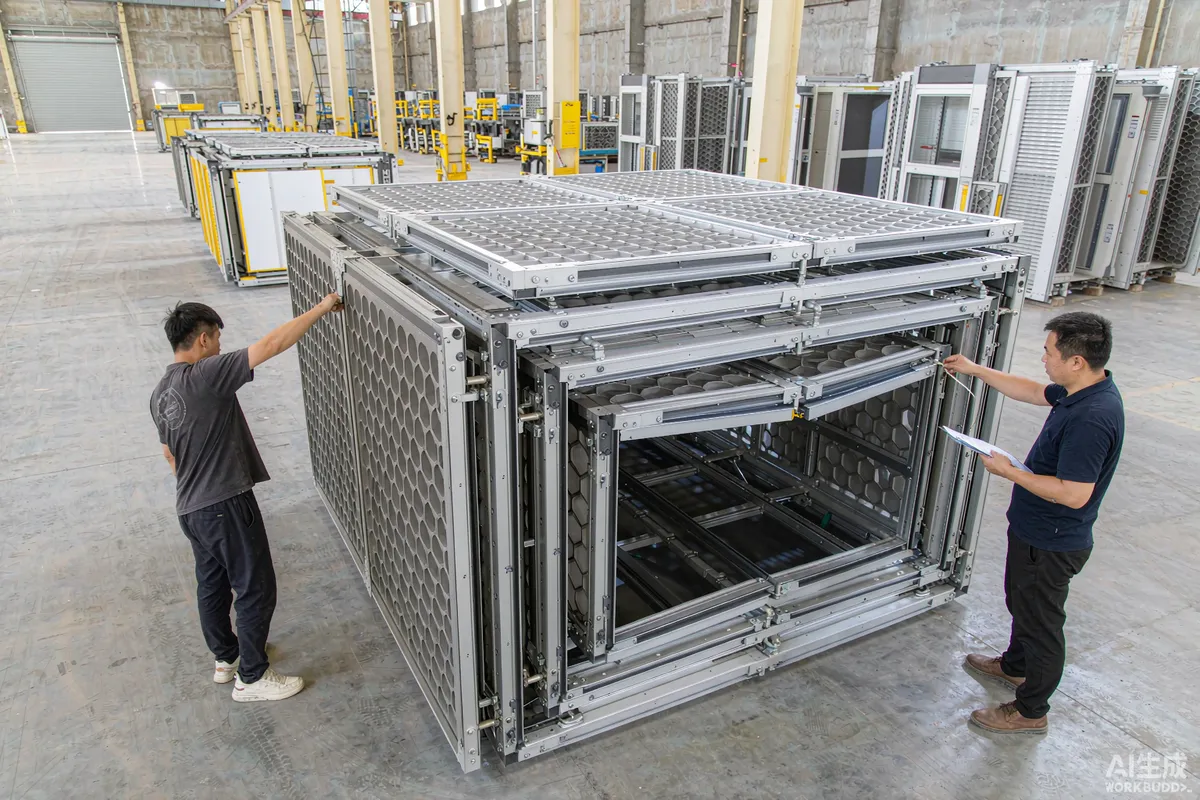
What to Ask the Factory Before Ordering
- Can the unit be demonstrated folded and unfolded? A video of a real unit is worth more than a drawing.
- How many cycles is the mechanism rated for? Get a number and how it was established.
- What is the spare parts list and lead time? Hinges, rollers and seal profiles should all be orderable.
- Who performs deployment - your crew, the dealer, or a factory technician?
- What does the warranty say specifically about the moving parts? Moving parts are often treated differently from the structure.
- Is there a written deployment procedure with photographs and a lock count?
Keeping It Working
An expandable unit that is deployed once and left alone needs very little: an annual look at seals, a check that locks still pull the panels fully home, and clean rails. An expandable unit that is moved repeatedly - for event use, seasonal repositioning or a rental fleet that relocates - needs a proper log.
- Record each deployment, with date, crew and any issue found.
- Inspect seals before every redeployment and renew on condition, not on a fixed guess.
- Keep rails clean and lightly lubricated as specified by the manufacturer.
- Re-torque lock-down fixings after the first week and then annually.
- Keep a spare seal set on site if downtime is expensive for your operation.
Standards and Approvals
Whether an expandable unit is acceptable where you are placing it depends on how the local authority classifies it, on the occupancy, and on which standard applies to the structure and its services. That classification is a question for your local building department or a licensed professional, not for the factory's sales material. Requirements may vary by application, market and applicable standard. Confirm the classification before you order, because it can affect everything from the foundation to the electrical connection.
A Short Checklist
- See the mechanism operate on a real unit.
- Get the rated cycle count in writing.
- Get the spare parts list with lead times.
- Confirm the sealing detail has two lines of defence plus drainage.
- Confirm the deployment procedure is documented with a lock count.
- Confirm warranty treatment of moving parts specifically.
- Confirm the local classification of the unit before ordering.
An expandable prefab house is a good answer when transport width is the binding constraint, when a site is hard to reach with a wide load, or when the whole point is that the unit can move. Understand the mechanism first, get the wearing parts documented, and the design does what it promises.
More from the Blog

Capsule Home Cost Guide: What You Really Pay in 2026
EXW, shipping, install and the hidden line items — a transparent breakdown of total landed cost.
Read article →
How to Install a Capsule Home in 3 Days: A Step-by-Step Guide
From site prep to first guest — the exact sequence our install crews follow on every deployment.
Read article →
Real Owners, Real Numbers: Success Stories
How a lakeside resort, a Spanish glamping site and a Singapore dealer hit their targets.
Read stories →Talk to the Factory
Ready to Ride the 2026 Wave?
Get the latest catalog, pricing tiers and a layout sketch for your land — straight from the engineering team.