Modular Home Inspection: Factory and Site Checks
Modular home inspection as five hold points: drawing release, in-line checks, pre-shipment packing, arrival damage and commissioning, with who signs.
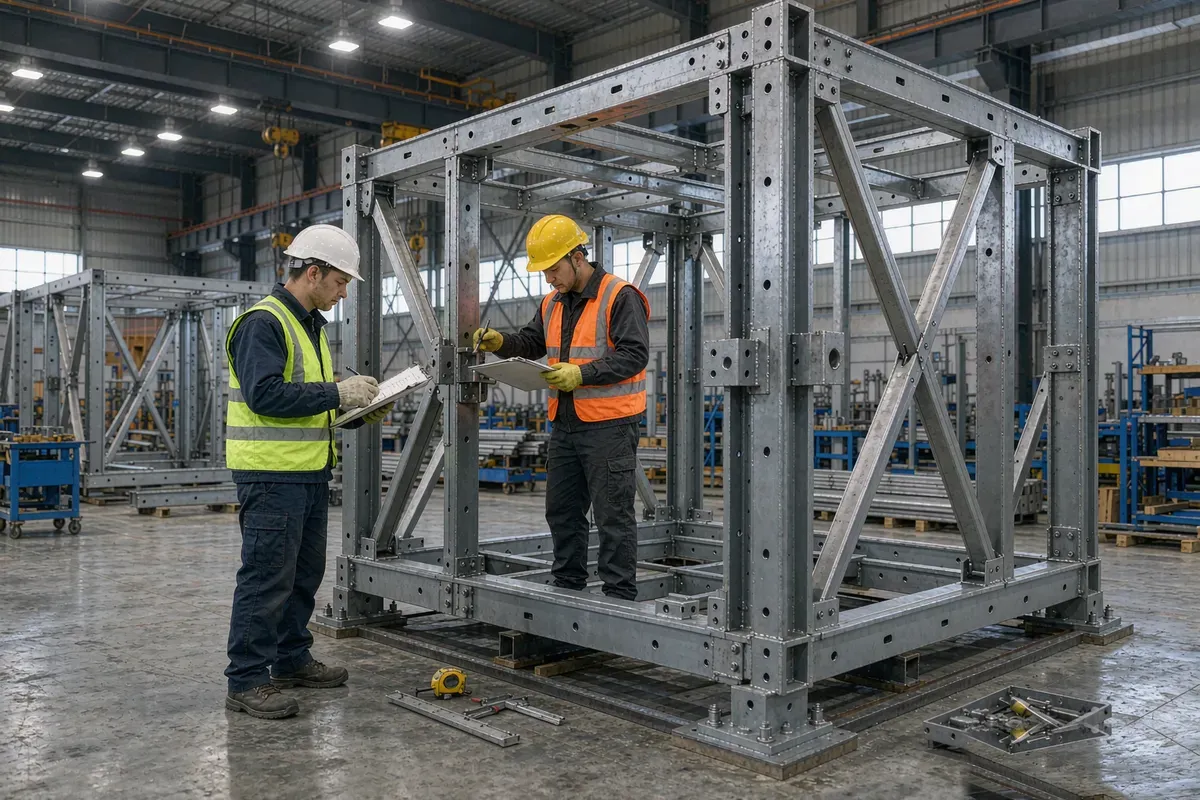
A modular home inspection is not a single event at the end of the build. It is a sequence of hold points, and each one is the last moment a specific element is still visible, still accessible, or still inexpensive to correct. This page sets out the five checkpoints that matter on a factory-built unit: drawing release before production, in-line checks while the structure is still open, pre-shipment inspection and packing, arrival damage check, and post-installation commissioning. For each one it covers who signs, what the record should contain, and what happens if the point is skipped. A factory audit answers a different question — whether a supplier is capable in general — and that is set out separately in the capsule house factory audit checklist. The production sequence itself is described in how a prefabricated capsule house is manufactured, the document set to request and verify is covered in capsule house certification and documents, and the cost consequence of a failed arrival check is part of capsule house installation cost.
Why inspection works as a sequence, not an event
The value of an inspection comes almost entirely from timing. A wiring run checked before the wall lining is fitted can be re-routed in an hour. The same run checked after lining means removing finished surfaces, then making them good, then repainting — and the repair is now permanent evidence in a room the guest will see. A panel joint checked before the unit is crated is a sealant bead. The same joint found leaking after arrival is a claim, a delay, and a unit that cannot be let.
So the practical question for a buyer is not "will it be inspected" but "at which points, by whom, and with what record". Every supplier inspects. The difference between suppliers is whether the inspection happens at a moment when a defect can still be corrected inside the factory, and whether the result is written down in a form you can refer to eighteen months later.

Checkpoint one: drawing release before production
The first hold point happens before any material is cut. It is a document review, and it is the only checkpoint where a design problem can be fixed at zero cost.
What to verify at release
- The specification matches the order. Model, dimensions, glazing configuration, door positions, interior layout, finish schedule, and every optional item listed in the order confirmation.
- Service entry positions. Where power, water and drainage enter the unit, and on which side. These are set by your site, not by the factory default.
- Transport envelope. Overall width, height and weight in the shipping state, and whether the configuration fits the road or port limits on your route.
- Site interface. Foundation type assumed by the drawings, and the tolerance the unit needs when it lands.
Who signs, and what the record holds
Buyer signs the released drawing set, or confirms acceptance in writing. The record is the drawing set with a revision number, a date, and a written acceptance. Anything agreed verbally afterwards needs to come back as a revised drawing with a new revision number. Without that, the factory builds to the last revision it holds, and both sides will be right.
Checkpoint two: in-line checks while the unit is still open
In-line inspection means checking during assembly rather than at the end. On a modular unit there are two moments that matter more than the rest.
Structure and envelope before closing
Check the frame, the fixings, the welds or bolted connections, the insulation installation and the vapour control layer while they are exposed. Confirm the glazing is bedded and sealed as specified, and that penetrations for services are sleeved and sealed rather than cut and forgotten.
Services before the lining closes
Check cable routing, containment, junction positions, pipe runs, fall on waste pipes, and insulation continuity. Confirm that the electrical protective devices fitted match the schedule, and that any equipment supplied loose is actually on the packing list and not assumed to be in the unit.

Checkpoint three: pre-shipment inspection and packing
This is the checkpoint most buyers skip, and it is the one that decides whether the arrival check has anything to find. The inspection has two halves: the unit, and the packing.
On the unit, walk the finished item against the specification: every door and window opens and latches, every appliance is present and marked, surfaces are free of transport-handling damage, and the wet areas hold water without leaking. On the packing, check the crate or frame is built to the declared standard, that the unit is restrained rather than merely resting, that moisture-sensitive items are wrapped with a desiccant, and that anything shipped loose is counted, labelled and listed.
The photographic record matters here more than the paperwork. Photograph the unit from all four sides, the serial or identification plate, and the packing both closed and — if possible — at the moment before closing. Those images are what a later claim is argued from.
Checkpoint four: arrival damage check
The arrival check is a condition check, not a quality inspection. It answers one question: did the unit arrive in the condition in which it was dispatched? That comparison is only possible if checkpoint three produced photographs and a packing list.
Check the exterior before the transporter leaves. Photograph any damage with the transport documents visible. Note damage on the delivery note before signing, and notify in writing within the period set in your order. If the unit is crated and cannot be opened immediately, note the external condition of the crate and any indicator or tilt device fitted.
Checkpoint five: post-installation commissioning
Commissioning is where the installation is tested as a system rather than as parts: electrical testing and protective device operation, water and drainage under flow, heating and cooling under load, ventilation rates, door and window operation after the unit has settled on its foundation, and any control or monitoring equipment.
The output is a commissioning record: what was tested, the method, the result, and who witnessed it. That record is also the starting point for the defect liability conversation at handover, so it should name the date from which the liability period runs.
Who signs what
| Checkpoint | What is checked | Signed by | Record produced |
|---|---|---|---|
| Drawing release | Specification, service entries, transport envelope | Buyer | Revision number and written acceptance |
| In-line | Structure, envelope, services before closing | Factory quality function | Stage check sheet and photographs |
| Pre-shipment | Finished unit and packing standard | Supplier, buyer or appointed representative | Inspection report, packing list, photographs |
| Arrival | Condition against dispatch record | Buyer or site representative | Delivery note with exceptions, photographs |
| Commissioning | Systems under load | Installer and buyer witness | Commissioning record, defect list |
Five questions to put to a supplier before ordering
- At which production stages can a buyer or a buyer's representative attend, and how much notice is required?
- What written record is produced at each stage, and will it be provided as part of the order rather than on request?
- What is the packing standard, and what photographic record is provided before the container or truck is sealed?
- What is the notification period for transport damage, and what documents does a claim require?
- Who commissions the services on site, and does the commissioning record state the date the liability period starts?
Whether an independent third party is involved is a separate commercial decision, and not something to assume is included. If your project, your lender or your market expects independent inspection, appoint it and name it in the order. Any certificate or conformity document referred to in a quotation should be requested from the supplier and verified against the issuing body before it is relied on. Requirements may vary by application, market and applicable standard.
More from the Blog

Capsule Home Cost Guide: What You Really Pay in 2026
EXW, shipping, install and the hidden line items — a transparent breakdown of total landed cost.
Read article →
How to Install a Capsule Home in 3 Days: A Step-by-Step Guide
From site prep to first guest — the exact sequence our install crews follow on every deployment.
Read article →
Real Owners, Real Numbers: Success Stories
How a lakeside resort, a Spanish glamping site and a Singapore dealer hit their targets.
Read stories →Talk to the Factory
Ready to Ride the 2026 Wave?
Get the latest catalog, pricing tiers and a layout sketch for your land — straight from the engineering team.