Capsule House Riyadh vs Jeddah: Two Climate Specs
Capsule house in Riyadh versus Jeddah: inland dust and temperature swing against Red Sea humidity and salt, and one base unit with two written option packs.
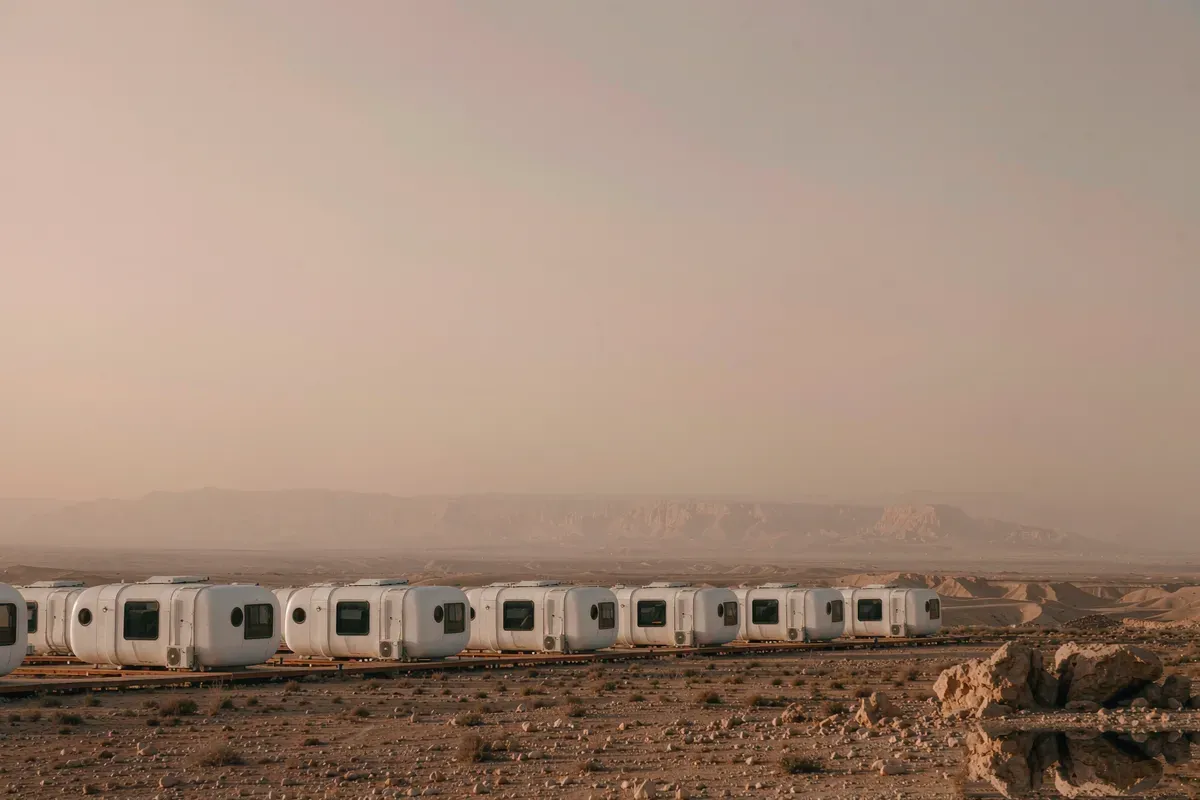
Saudi Arabia is not one climate. A unit destined for the inland plateau around Riyadh and the same unit destined for the Red Sea coast near Jeddah face different problems, and specifying one configuration for both is how an owner ends up over-equipped in one place and exposed in the other. This page sets out the two regimes, what each one does to the envelope, the cooling duty, the sealing strategy, the water and drainage assumptions and the shading priorities — and how a fleet buyer standardises one base unit with two option packs instead of two separate designs. Country-level planning context stays in the capsule house Saudi Arabia guide, general hot-climate guidance stays in capsule houses in a hot Saudi climate, and the commercial side sits in capsule house price in Saudi Arabia and the general capsule house price page. Regulatory questions are a separate subject; confirm anything applicable with the authority having jurisdiction.
Regime one: the inland plateau
The defining characteristic inland is not the peak temperature alone, it is the swing. Clear skies and dry air allow the surface to lose heat quickly after sunset, so the difference between an afternoon peak and a pre-dawn low is large, and the daily cycle is repeated rather than seasonal.
- What it does to the envelope. A large daily temperature cycle drives expansion and contraction in the frame and the panel joints. Sealing detail and joint design matter more here than raw insulation thickness.
- What it does to cooling. Peak load arrives in a short afternoon window, then falls away. A plant sized only for the peak may cycle inefficiently for the rest of the day.
- What it does to water. Condensate production is modest because the air is dry, and the dominant water issue is supply and storage rather than disposal.
- What it does to air quality. Fine airborne dust is the daily reality. Every opening in the envelope is a candidate entry point, and filtration becomes a consumable with a real cost and a real change interval.
Regime two: the Red Sea coastal belt
Coastal Jeddah trades the temperature swing for humidity. The afternoon peak may be lower, but the night does not cool in the same way, and the air carries moisture and salt.
- What it does to the envelope. Humidity plus a cooled interior means the dew point is a genuine design variable. Cold surfaces, particularly at the frame and around penetrations, can attract condensation.
- What it does to cooling. Latent load — the energy spent removing moisture — becomes a larger share of the duty. A plant sized on sensible heat alone will run long cycles without ever making the room feel dry.
- What it does to water. Condensate volumes are significant and continuous. Drainage has to be designed, trapped and maintained rather than improvised.
- What it does to materials. Salt-laden air attacks fixings and uncoated metal first. Fastener and coating specification shifts up the priority list, and sacrificial items become a planned consumable.

Side by side
The comparison is easier to act on as a table than as prose. Read it as a list of what to raise with your supplier, not as performance data.
| Decision | Inland plateau | Red Sea coast |
|---|---|---|
| Envelope priority | Joint movement and dust sealing | Condensation control at cold surfaces |
| Cooling duty | Short high peak, long low tail | Continuous duty with a large latent share |
| Sealing | Fine dust ingress at every opening | Water and humidity management |
| Corrosion | Low priority | High priority at fixings and exposed metal |
| Water handling | Supply and storage planning | Condensate drainage as a designed system |
| Shading | Reduce peak gain; dust cleaning burden | Reduce gain; shading also shelters from salt spray |
One base unit, two option packs
For a buyer ordering more than a handful of units, the answer is usually not two designs. It is one standardised base — the same frame, the same layout, the same finishes, the same spares — plus a written option pack applied at order time:
- Cooling pack. Plant capacity and control strategy selected against the site regime, with condensate handling included or excluded accordingly.
- Sealing pack. Additional sealing and filtration provision for dust inland; a different emphasis on water management and corrosion protection on the coast.
- External metals pack. Fastener and coating specification raised for coastal exposure, and sacrificial items identified by name so they can be ordered with the first shipment.
- Maintenance pack. Different intervals: filter changes dominate inland, rinsing and inspection dominate on the coast.
The benefit is not only technical. One base unit means one set of spare parts, one set of operating instructions, and staff who move between sites without relearning the building. The option pack is where the difference lives, and it should be a document you can attach to an order rather than a conversation.

What to ask for, and what not to assume
Do not ask a supplier to confirm that a unit is "suitable for Saudi Arabia". The question does not have an answer, because the country contains both regimes and several others besides. Ask instead:
- Which assumptions are built into the quoted configuration — dry inland or humid coastal — and what changes in the other case.
- What the quoted sealing specification covers, and what is excluded.
- What coating and fastener specification is quoted, and whether a coastal upgrade is offered.
- What condensate provisions are included, and what the site must provide.
- Which figures, if any, are supported by a test report, and under which standard.
Where a performance figure is offered, ask for the document behind it and verify it against the applicable standard rather than accepting the number. No climate statistics are quoted here as measured data for a specific site; a designer should use locally recorded data for the plot. Requirements may vary by application, market and applicable standard.
The cost of standardising wrongly
The two failure modes are mirror images. Specify the coastal pack for an inland site and you have paid for corrosion protection that will never be tested, while under-providing for dust. Specify the inland pack on the coast and the first summer produces condensation complaints, corroding fixings and a condensate problem nobody designed a drain for. Both are avoidable at the specification stage and both are expensive afterwards, which is why the option pack is worth writing down before the order rather than after the first season.
Commissioning and operating differences
The two regimes diverge again after handover, and the operating manual should reflect which one the unit is standing in. Inland, the recurring tasks are filter changes, seal inspection after dust events and checking that joints have not opened with the daily cycle. On the coast the recurring tasks are condensate drain checks, rinsing of exposed metal, and inspection of fixings for early corrosion. A single generic maintenance schedule applied to both sites will over-service one and under-service the other.
The same applies to complaints. Inland, guest discomfort usually presents as a room that is hot in the afternoon and fine by midnight. On the coast it presents as a room that feels damp or clammy even when the thermostat reads correctly, which is a latent load and ventilation question rather than a capacity question. Training staff to describe the symptom accurately is worth more than an extra service visit, because the two faults have opposite remedies.
More from the Blog

Capsule Home Cost Guide: What You Really Pay in 2026
EXW, shipping, install and the hidden line items — a transparent breakdown of total landed cost.
Read article →
How to Install a Capsule Home in 3 Days: A Step-by-Step Guide
From site prep to first guest — the exact sequence our install crews follow on every deployment.
Read article →
Real Owners, Real Numbers: Success Stories
How a lakeside resort, a Spanish glamping site and a Singapore dealer hit their targets.
Read stories →Talk to the Factory
Ready to Ride the 2026 Wave?
Get the latest catalog, pricing tiers and a layout sketch for your land — straight from the engineering team.