Capsule House Water Supply Planning: Indonesia
Capsule house water supply in Indonesia: boundary supply, groundwater and salt intrusion, rainwater, hauled water, storage, pumping, wastewater and testing.

Water is the utility most often assumed and least often verified on an Indonesian capsule house project. Power has a visible test: switch something on. Water has four separate questions that are usually answered together and should not be: where it comes from, whether it is drinkable, how much can be stored, and where the used water goes. This page is about those four, in the conditions that apply on Indonesian island and coastal sites. Off-grid power and energy is a separate subject and stays in off-grid capsule houses in Indonesia; humidity and envelope behaviour is also separate. Market context is in the capsule house Indonesia guide, and the cost side sits in capsule house price in Indonesia and the general capsule house price page. No yield, quality or treatment performance figure is claimed here; test locally and confirm requirements with the authority having jurisdiction. Requirements may vary by application, market and applicable standard.
Start with the boundary question
Before any equipment is selected, establish one fact in writing: is there a piped utility supply at the site boundary at all? On many island and rural plots the answer is no, or yes-but-not-yet, and the difference drives the entire design.
- Supply exists at the boundary. Establish the connection process, the expected lead time, whether the supply is continuous or intermittent, and the pressure actually available at the boundary rather than the nominal pressure in a brochure.
- Supply exists nearby but not at the boundary. The extension is a project with its own cost, its own permissions and its own schedule, and on a road crossing or along a coastal strip it may be the longest lead item on the site.
- No supply. The site is self-supplying, and storage volume, source reliability and treatment become design parameters rather than accessories.
Treat the answer as a document. A verbal assurance from a broker or a neighbour is not a basis for sizing a tank farm.
Groundwater: the option that needs the most investigation
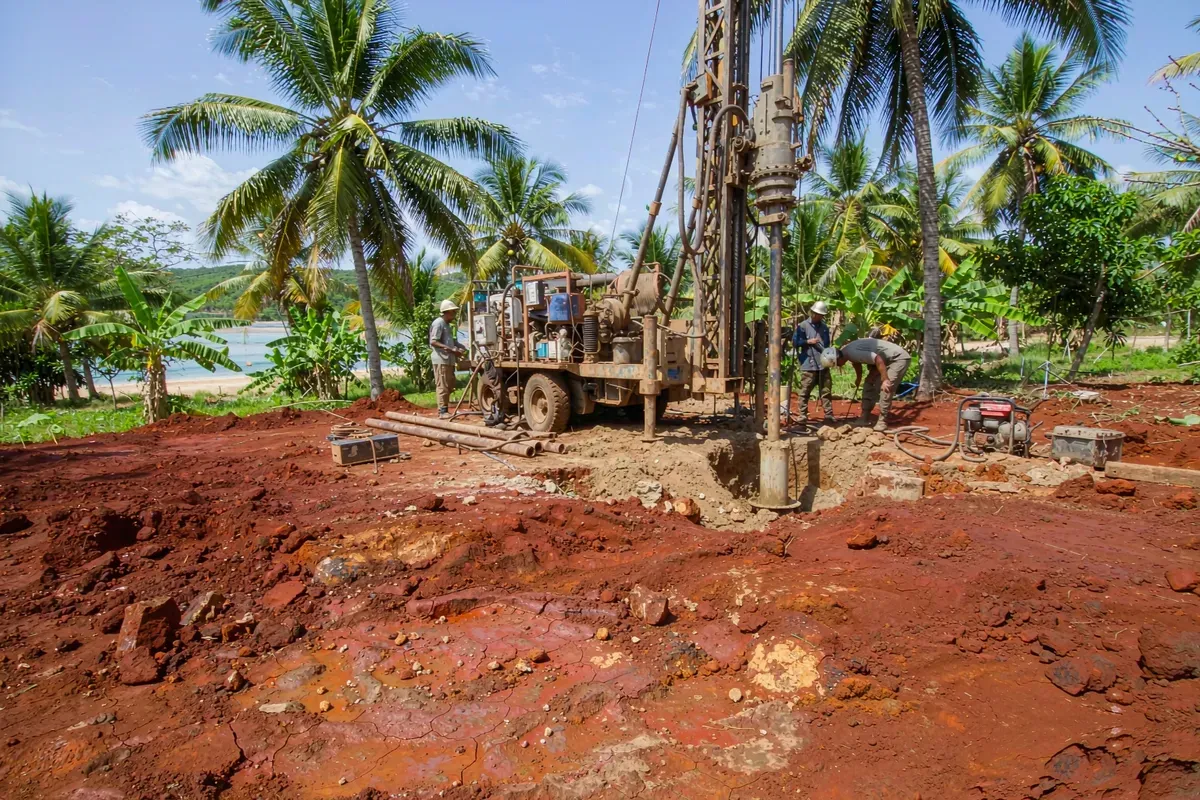
Drilling is attractive because it appears to solve everything at once. On a small island it is the option most likely to disappoint, for reasons that are geological rather than commercial:
- The freshwater lens is thin. On many small islands a limited body of fresh water floats on denser salt water. A bore that is too deep, or pumped too hard, draws the salt water upward and contaminates itself.
- Salt intrusion is progressive. A bore that is fresh in the first season can become brackish after a dry period or after neighbouring extraction increases.
- Yield is seasonal. Recharge depends on rainfall that may be concentrated into a few months.
- Quality is unknown until tested. Iron, manganese, hardness and bacterial contamination are all common, and each has a different treatment response.
The correct sequence is investigate, then commit: a hydrogeological assessment appropriate to the island, a test bore, a yield and quality test at the end of the dry season rather than the wet one, and only then a decision on pump sizing. Skipping straight to drilling is a common way to spend money twice.
Rainwater: a supplement, not a promise
Rainwater collection is genuinely useful on an Indonesian site and is frequently oversold. The arithmetic is unforgiving: catchment area, seasonal distribution and storage volume have to be reconciled, and the dry interval is what sizes the tank, not the annual total. Practical points:
- Treat collected rain as a supplement to another source unless the catchment and storage are demonstrably adequate through the dry season.
- Roof material and condition matter for water quality. A metal roof over a coastal site accumulates salt and organic debris; first-flush diversion and filtration are not optional.
- Storage needs a foundation, shade and a cleaning regime. A tank on soft ground beside a unit is a structural and a hygiene problem.
- If the water is for guests to drink, treatment and testing requirements rise substantially, and they should be confirmed with the relevant authority.
Hauled water: what it really costs
Where there is no piped supply and no reliable groundwater, water arrives by truck or by boat. Buyers tend to price the water and forget everything else:
- Delivery reliability depends on weather, on the vessel or vehicle, and on the landing or road conditions. A resort that runs out of water is closed, whatever the occupancy.
- Storage volume must bridge the interval between deliveries, including a margin for a missed delivery. This is the single largest space and structure commitment on the plot.
- Landing or access infrastructure for a water boat or a tanker is a site works item with its own cost.
- Source quality varies by supplier. Test each source, not once but periodically.
Storage, pumping and pressure
Almost every Indonesian capsule site ends up with storage, whether it is the primary source or a buffer against an intermittent supply. Design decisions that matter:
- Where the tank sits. Elevated storage gives pressure by gravity and works during a power cut; ground-level storage is easier to build and to clean but needs a pump to deliver pressure. Elevating a tank means a structure designed for the load, which is engineering work.
- How much. Size for the interval you must survive, not for the average day. Include the fire-fighting provision the authority may require, since that is often the governing case.
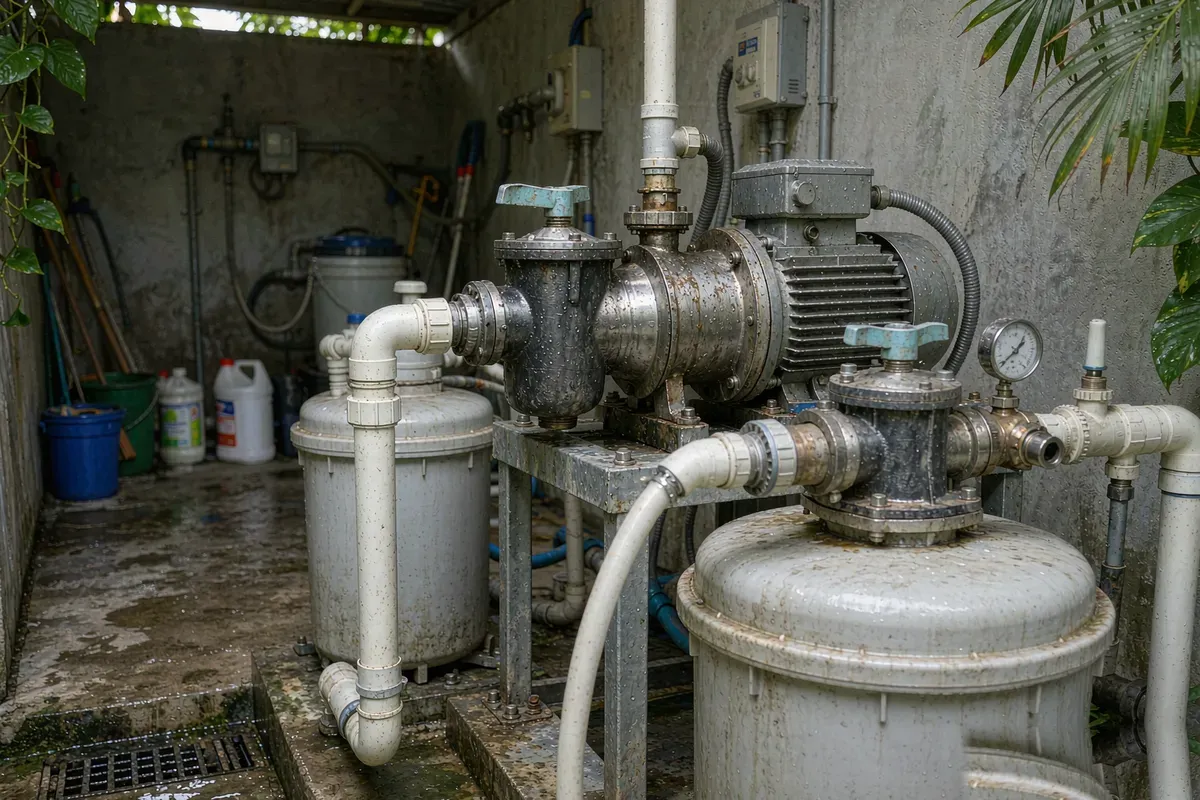
- Pumping with intermittent power. Where the supply is unreliable, a pump that restarts under load, or that runs dry, fails. Specify dry-run protection and a restart behaviour, and ask what happens after an outage.
- Pressure stability. Guests notice pressure variation more than flow rate. A pressure vessel or a variable-speed set gives a stable shower; a pump that cycles does not.
- Hot water. A point-of-use or central system changes both the electrical load and the maintenance plan, and on a humid site the insulation and vapour sealing of pipework matters more than in a temperate climate.
Greywater, blackwater and treatment
Where the water goes is usually the item that a resort discovers late, and it is the item that most affects neighbouring relationships and regulatory standing. Separate the streams:
- Greywater from showers and basins is the larger volume and the easier stream to manage, but it still needs a controlled discharge, not a pipe onto the ground.
- Blackwater needs containment and treatment. On a single plot the usual options are a septic tank with a properly designed soakaway, or a package treatment plant where discharge quality or space requires it.
- Soakaway performance depends on soil and on the water table, both of which are site-specific and both of which change in the wet season. Test percolation on the actual plot.
- Discharge to any watercourse or the sea is a permission question, and the applicable standard should be confirmed with the authority having jurisdiction rather than assumed from a neighbouring property's practice.
Testing before guests drink it
Two tests are worth building into the operating routine, regardless of source:
- Commissioning test. Before first occupancy, test the water that will actually be delivered to the tap for the parameters the relevant authority specifies. Record the result and the laboratory.
- Periodic test. Sources change. A bore that was acceptable can become brackish, a tank can become contaminated, and a hauled supply can change supplier. Test on a schedule, retain the results, and treat an out-of-range result as an operating incident.
If the water is not tested, the safe assumption is that it is not potable. Provide treated drinking water separately, label the taps clearly, and say so in the guest information. That single decision removes most of the risk from a subject that rarely gets the attention its consequences deserve.
Questions for the supplier and the site team
- What is the unit's cold water connection size and location, and what pressure range is it designed for?
- Is the hot water system part of the factory scope or a site item, and what is its electrical load?
- What are the waste outlet positions and sizes, and are grey and black streams separate at the unit?
- What access is provided to the service void for maintenance and for leak inspection?
- Who confirms that the installed water system meets the applicable local requirement before handover?
More from the Blog

Capsule Home Cost Guide: What You Really Pay in 2026
EXW, shipping, install and the hidden line items — a transparent breakdown of total landed cost.
Read article →
How to Install a Capsule Home in 3 Days: A Step-by-Step Guide
From site prep to first guest — the exact sequence our install crews follow on every deployment.
Read article →
Real Owners, Real Numbers: Success Stories
How a lakeside resort, a Spanish glamping site and a Singapore dealer hit their targets.
Read stories →Talk to the Factory
Ready to Ride the 2026 Wave?
Get the latest catalog, pricing tiers and a layout sketch for your land — straight from the engineering team.