Capsule House Price Vietnam: Landed Cost Guide
Capsule house price in Vietnam built as a landed cost: gateway port, duty and taxes, long inland haulage, coastal-sand foundations and service capacity.

A capsule house price for Vietnam only makes sense as a landed cost. The factory line is real, but a Vietnamese project adds ocean freight to a gateway port, port handling, import duty and taxes, inland haulage that can be long and slow, site works on coastal or sloping ground, foundation, utility connection, crane and set, commissioning, and consultant and permit fees. Two of those lines — inland haulage and site works — move a Vietnamese total more often than an upgrade to the unit does. This page sets out the chain and what you can influence at each stage. For the general pricing framework, see our capsule house price page; for climate, siting and coastal development in Vietnam, see the Vietnam regional page.
The Chain, In the Order Money Is Committed
| Line | Quoted by | Your influence |
|---|---|---|
| Unit and configuration | Factory | High — the main lever you fully control |
| Export packing and loading | Factory | Medium — transport form is fixed here |
| Ocean freight and insurance | Carrier | Low — route and season set the market |
| Port handling and terminal charges | Port | Low — published schedules |
| Import duty and taxes | Authority | Low — but classification is yours to establish |
| Inland haulage | Local carrier | Medium — access survey changes vehicle and route |
| Site works and foundation | Your contractor | High — soil and slope drive this hard |
| Utility connection | Utility / contractor | Medium — distance and existing capacity |
| Crane and set | Local contractor | Medium — access and ground bearing |
| Commissioning and snagging | Factory + your team | Medium — inspect before acceptance |
| Consultant and permit fees | Your advisers | Medium — scope of approvals work |
Read the chain once before you compare suppliers. A quotation that looks lower on the unit line can be higher at the bottom if the transport form forces an out-of-gauge move, or if the configuration needs a wider road than the site has.
Where the Unit Lands
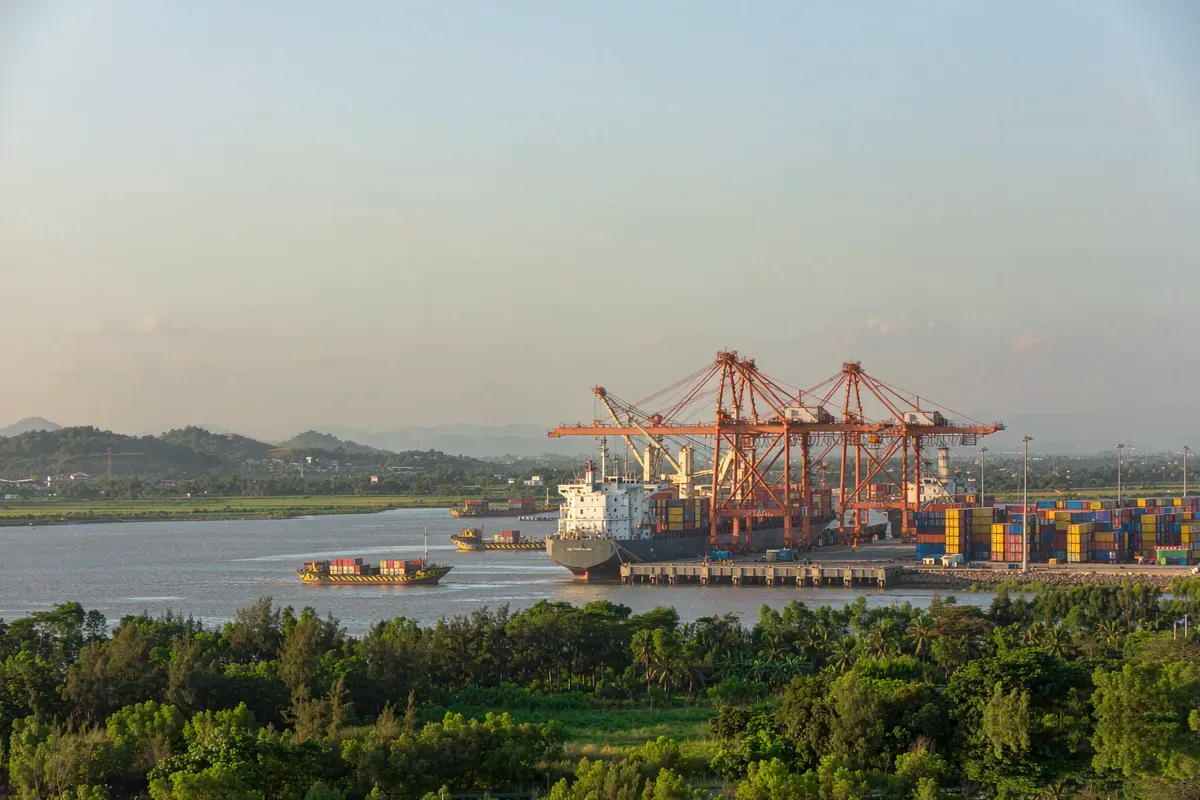
Vietnam's shape dictates the decision: a long coastline with the main load centres separated by a great distance. In practice the gateway follows the site — northern projects generally serve from a northern port, central projects from a central port, southern projects from the southern port cluster around Ho Chi Minh City. Choose the discharge port from the site inward, then price the ocean leg to it. The reverse order produces a cheap freight quote and an expensive haul.
Confirm with your forwarder which port they intend to route through, whether the service is direct or transshipped, and what the transshipment adds in time. Transshipment is normal; the risk is that it lengthens the window during which free days at destination can expire.
Duty, Taxes and Classification
Import duty and value added tax are applied against the declared classification and customs value. Classification is established in the importer's declaration, which means it is your responsibility, not your supplier's and not automatically your forwarder's default. Ask your forwarder to confirm the heading they intend to use, in writing, before shipment, and ask what duty and tax treatment follows and whether any relief or exemption applies to the project.
Vietnam is party to free trade arrangements under which a certificate of origin may support preferential treatment, subject to the rules of the relevant arrangement and to the goods qualifying. Eligibility has to be established before importation, not claimed afterwards. Requirements may vary by application, market and applicable standard.
Budget for the possibility that a used or previously imported unit is treated differently from a new one, and that temporary import for a specific project may be a separate regime with its own re-export obligation. Ask before you commit, in both cases.
Inland Haulage: The Line That Surprises People
Vietnamese haulage is often longer, slower and more route-constrained than a first budget allows. Survey before you order: road width at the narrowest point, bridge and culvert limits, overhead restrictions, ferry crossings, urban access restrictions and permitted hours, turning radius at the site, and ground bearing where the crane will stand. Abnormal load permits, where required, are applied for against a confirmed route and take time.
Coastal resort sites add a further problem: sand. Soft, saturated or loose coastal ground has low bearing capacity, which affects both the haulage vehicle's ability to reach the setting position and the crane's ability to work there. A crane pad or a temporary working platform is a real budget line, and it is site-specific.
Site Works and Foundation
Foundation type follows ground conditions and, on the central coast, wind uplift. Expect a geotechnical investigation as a normal project cost rather than an optional extra. On coastal sand, a piled or ground-improved solution is common; on sloping highland ground, a pier or stepped pad solution with surface water management. In a typhoon-exposed location the anchoring design is part of the foundation, not an accessory bolted on afterwards — our typhoon page for central Vietnam covers what to ask for.
Site works also include the surface water plan. Vietnamese rainfall is intense; where the water goes after it leaves the roof decides whether the foundation stays put.
Comparing Two Offers Properly
Most bad comparisons come from offers that are not describing the same thing. Put both on the same axes before you look at totals:
- Configuration. Same model, same layout, same glazing extent? A larger panoramic panel is a different product.
- Envelope. Same build-up and same stated thermal performance for the assembled unit, not just the panel?
- Glazing. Single or double, thermal break, safety specification, replacement lead time.
- Electrical. Vietnam operates on a 220 V / 50 Hz supply. Confirm the unit is wired and protected for it, and that appliances are rated for it. Socket types in use vary; agree the configuration before production.
- Transport form. Container, flat-rack or out-of-gauge — changes the freight and handling lines materially.
- Incoterm and scope. Which party bears freight, insurance, clearance and inland haulage?
- Warranty and spares. Duration, exclusions, and how a part reaches your site.
- Payment terms and currency. Deposit, progress payments, balance trigger, and the currency each is denominated in.
Ask each supplier to price the same written specification. If one will not, you have learned something useful about how they will behave later.
Quantity, Lead Time and Payment Structure
Unit cost responds to configuration and to quantity, and lead time responds to the production schedule at the time you order. Both are worth discussing early because they interact: a standard production slot with a frozen specification is usually quicker than a bespoke one, and an order that changes after production starts costs more than a change made during specification. Payment terms are part of the commercial structure rather than a detail — agree the deposit, the progress triggers and the balance condition in writing, along with the currency each is denominated in.
What We Do and Do Not Publish
We publish no price figures on this site. Unit cost depends on configuration, quantity, specification and date; freight depends on route, carrier and market conditions; duty and tax depend on classification and the rules in force at importation; site works depend on your ground. Only your suppliers, forwarder and consultants can establish these for your project, and a published number would be misleading in either direction.
What to Send Us
Send the site province, access conditions and any survey information, the configuration and quantity, and your target opening date. We will quote what we control and name what you must source locally. Review the Galactic A series configurations and send your project details through the contact page.
More from the Blog

Capsule Home Cost Guide: What You Really Pay in 2026
EXW, shipping, install and the hidden line items — a transparent breakdown of total landed cost.
Read article →
How to Install a Capsule Home in 3 Days: A Step-by-Step Guide
From site prep to first guest — the exact sequence our install crews follow on every deployment.
Read article →
Real Owners, Real Numbers: Success Stories
How a lakeside resort, a Spanish glamping site and a Singapore dealer hit their targets.
Read stories →Talk to the Factory
Ready to Ride the 2026 Wave?
Get the latest catalog, pricing tiers and a layout sketch for your land — straight from the engineering team.