What Ships Inside a Capsule Home: A Practical Inventory Guide
What typically travels inside a space capsule home during transport, what ships separately, and the receiving checks that catch missing items before the carrier leaves.

Knowing what travels inside a capsule home - and what does not - turns delivery day from a surprise into a checklist. A factory-finished unit arrives with its structure, envelope and fixed interior in place. Alongside that, there are loose items packed inside the unit for transport efficiency, components that ship separately because of size or handling, and documents that should arrive with the shipment or ahead of it. Most delivery disputes come from a mismatch between what the buyer assumed was included and what the order actually specified. Requirements may vary by application, market and applicable standard.
Three Categories on Every Shipment
Sort the order into these three groups before dispatch and receiving becomes straightforward.
- Built in: anything fixed to the structure - wall and roof panels, glazing, doors, wiring, plumbing, built-in cabinetry, sanitaryware, fixed lighting, and the mechanical equipment mounted in the unit.
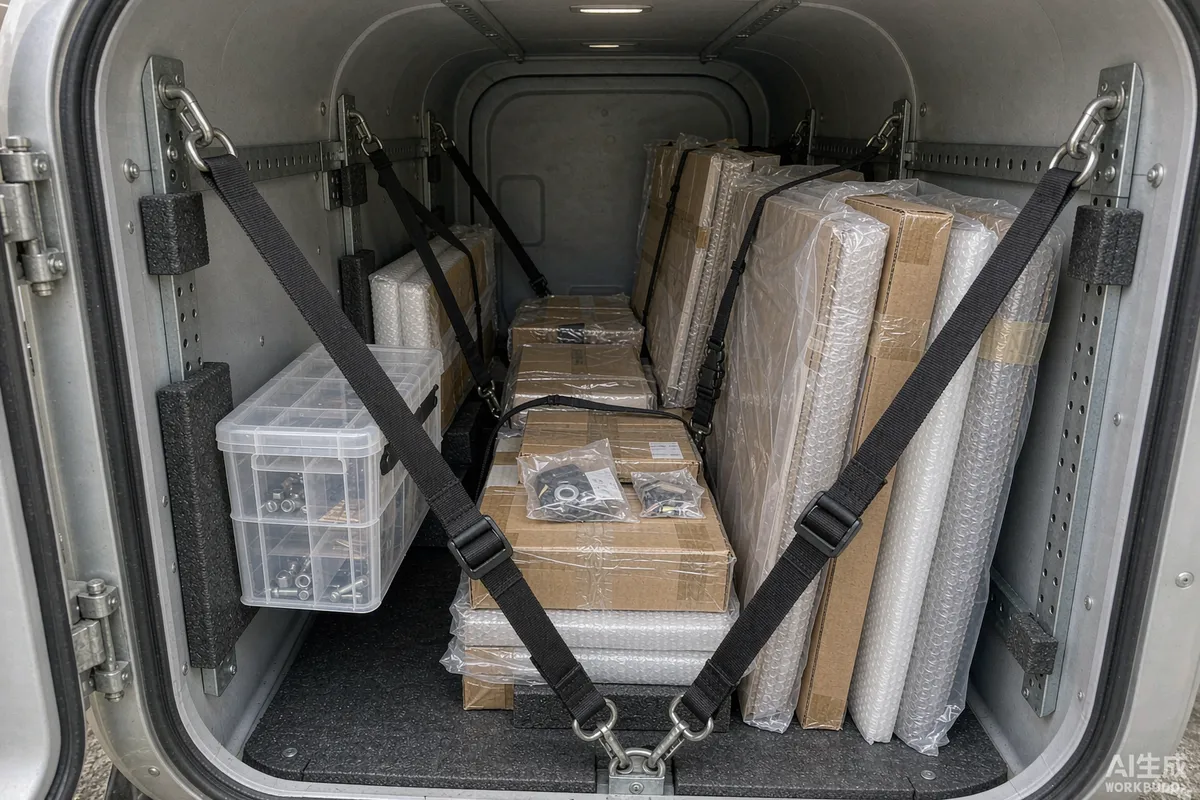
- Packed inside: loose or protective items placed in the interior for transit - furniture not fixed down, loose cushions, small appliances, removable shelves, spare parts and the document pack.
- Shipped separately: items too bulky, too fragile or too awkward to travel inside the unit - decking components, stairs, some canopies or pergolas, larger freestanding furniture, and spare-part crates.
The exact split is a specification question. Ask the supplier for a written packing list attached to your order, because the answer differs between models and between orders.
Why Anything Travels Inside at All
Packing loose items inside a unit is not an afterthought; it is usually the most practical way to ship them.
- Protection. The interior is a padded, enclosed space, better than a pallet exposed to handling.
- Space efficiency. Unused interior volume costs nothing extra to fill within the same transport envelope.
- Security. Items inside a sealed unit are less exposed to pilferage in transit than items on an open pallet.
- Handling count. Fewer separate pieces means fewer handling events and fewer opportunities for loss.
The trade-off is that anything packed inside must be secured so it cannot move, and must be unpacked and checked as soon as the unit is opened.
Items Worth Confirming in Writing
| Item group | Typical arrangement | What to confirm |
|---|---|---|
| Seating and soft furnishing | Often loose inside, sometimes shipped separately | Whether it is included in your specification at all, and how it is packed |
| Mattress and bedding | Frequently separate to keep it clean and dry | Quantity, size, and whether it ships with the unit or afterwards |
| Appliances | Built-in appliances installed; freestanding ones boxed | Voltage and plug type for the destination market, and whether appliances are part of the order |
| Lighting | Fixed lighting installed; decorative fittings may be boxed | Which fittings are installed and which require on-site fitting |
| Stairs, deck and terrace | Usually separate due to length and handling | Whether it is pre-cut, what fixings are supplied, and who assembles it |
| External shading or canopy | Often separate | Whether it is supplied, and whether installation is included |
| Spare parts and touch-up kit | Boxed inside or in a separate crate | Contents list, and where it is stored on arrival |
| Documents | With the shipment or sent ahead | Manuals, drawings, maintenance schedule, and any compliance paperwork for the destination |
Before Dispatch: Ask for These Four Things
- A written packing list that separates built-in, packed-inside and shipped-separately items.
- Photographs of the packed unit before sealing, including the interior with loose items secured.
- A total piece count for the shipment, so you can check that nothing is missing at the destination.
- A document list confirming which manuals, drawings and certificates travel with the goods and which arrive separately.
These four requests cost nothing and resolve most later disagreements. If the supplier cannot produce a packing list, that is itself information about how the shipment will be handled.
Receiving: Check Before the Carrier Leaves
The moment to identify a shortage is while the delivery team is still on site, not three days later by email.
- 1. Count the pieces. Compare against the total piece count on the transport documents before anything is signed.
- 2. Photograph the exterior from all sides, including any damage to packaging, before unloading.
- 3. Open and photograph the interior as soon as the unit is accessible, before anything is unpacked.
- 4. Work from the packing list. Tick built-in, packed-inside and separate items separately.
- 5. Note damage on the delivery documents in writing, with photographs, before the carrier leaves.
- 6. Store the document pack safely. Manuals and drawings are as easy to lose as any small item.
Where transport damage is involved, timing matters: carrier and insurance processes usually have notification windows. Photograph first, notify quickly, and keep everything in one folder.
Once It Is Unpacked: Three First Tasks
The hours after unpacking are when things get lost. Three quick tasks prevent most of it.
- Photograph the empty interior. A record of the unit as delivered, before furnishing, is useful for any later condition question.
- Store the document pack and spares together in a known place. Nominate one location and write it in the handover note; manuals that go into a drawer are manuals that are gone.
- Log serial numbers and model references. Appliances and equipment are far easier to support later when the references are on file rather than on the back of a unit behind a panel.
Common Causes of a "Missing Item"
In practice, most apparent shortages are not lost goods.
- The item was never in the specification. Resolved by checking the order, not by searching the unit.
- The item is in a different shipment. Separate items often travel on a different schedule.
- The item is inside a fixed element. Some storage compartments, beds and benches are used as packing space.
- The item is fitted, not boxed. What you expected as a separate box is already installed.
- The item was removed for transit and not yet refitted. Transit fixings and protective covers sometimes hide it.

Responsibility Boundaries During Transport
Knowing who is responsible at each stage is what turns a damaged shipment into a claim rather than an argument.
- Confirm the trade terms. The agreed delivery terms define where responsibility transfers, and they should appear on the order, not only in an email.
- Confirm what is insured. Cover for transport, for loading and unloading, and for the period the unit sits on site before installation can be three different scopes.
- Confirm who unloads. Whether cranage is arranged by the buyer or included changes both cost and responsibility.
- Confirm the storage plan. If the unit will sit before installation, where, on what ground, and under whose care.
- Confirm the notification route and window. Carrier and insurer processes are time-limited; know the deadline before you need it.
What Not to Expect in the Shipment
Setting expectations on the exclusions is as useful as listing inclusions.
- Site works. Foundation, services, access and cranage are normally separate scopes.
- Local approvals. Consents, permits and inspections are the buyer's responsibility in most arrangements.
- Consumables. Bedding, towels, kitchenware and welcome items are usually operator-supplied.
- Import clearance. Duties, taxes and customs paperwork follow the agreed trade terms; confirm which party handles what.
- Anything not on the order. A packing list is only as good as the specification behind it.
Ask for the packing list early, keep it next to the delivery documents, and check piece count before the carrier leaves. That single habit prevents most of the disputes that otherwise consume weeks after an otherwise smooth delivery.
More from the Blog

Capsule Home Cost Guide: What You Really Pay in 2026
EXW, shipping, install and the hidden line items — a transparent breakdown of total landed cost.
Read article →
How to Install a Capsule Home in 3 Days: A Step-by-Step Guide
From site prep to first guest — the exact sequence our install crews follow on every deployment.
Read article →
Real Owners, Real Numbers: Success Stories
How a lakeside resort, a Spanish glamping site and a Singapore dealer hit their targets.
Read stories →Talk to the Factory
Ready to Ride the 2026 Wave?
Get the latest catalog, pricing tiers and a layout sketch for your land — straight from the engineering team.