Running a Capsule Home Park: Who You Need on the Team
A capsule home park is an operations business. Here are the roles, the workload per unit and the decisions you should systemise before you scale.

A capsule home park is not primarily a property business; it is an operations business that happens to own property. The units are the easy part. What determines whether the site earns is how reliably you can turn a unit between guests, fix the thing that broke, and answer the guest who arrives at nine at night and cannot work the heating.
This guide sets out the roles a small site needs, how the workload scales, and which processes are worth writing down before you add units.
The Four Functions
Every site, regardless of size, has to cover four functions. On a two-unit site one person may cover all four; on a twenty-unit site they are separate jobs. Naming them separately is useful even when one person does everything, because it stops the urgent from consuming the important.
| Function | What it owns | What breaks if neglected |
|---|---|---|
| Housekeeping | Turnover cleaning, linen, consumables, damage reporting | Reviews, re-cleaning, late check-ins |
| Maintenance | Envelope, glazing, plumbing, electrical, heating, grounds | Out-of-order nights, escalating repair cost |
| Guest communication | Pre-arrival info, check-in, in-stay support, check-out | Bad reviews driven by small unresolved issues |
| Revenue and admin | Listings, pricing, calendar, invoicing, compliance records | Lost bookings, pricing drift, compliance gaps |
Housekeeping: The Constraint That Sets Everything Else
Turnover capacity is usually the binding constraint on a small site. If a clean takes ninety minutes and you have one housekeeper, that is a hard limit on how many same-day turnovers you can accept - regardless of how attractive the demand is.
Work out the real number by timing an actual turnover with an actual person, including travel between units and laundry handling. Then build your changeover day around it rather than discovering the limit on a busy Saturday.
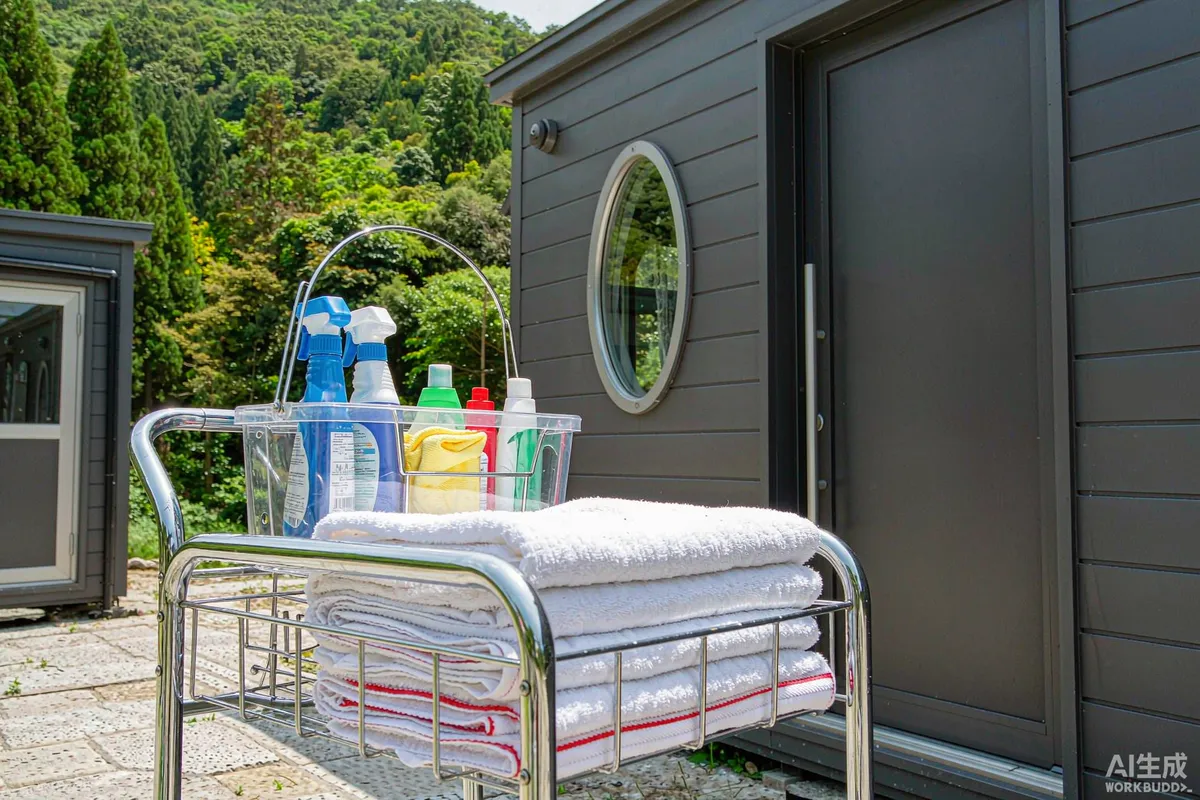
- Standardise the linen set so every unit uses the same items - it simplifies par stock and purchasing.
- Keep par stock of at least two sets per bed plus spares, so laundry delays do not block a changeover.
- Write the clean as a checklist with photographs of the standard.
- Make damage reporting part of the clean, not an afterthought - housekeeping sees problems first.
- Time your changeover realistically and hold a buffer for late check-outs.
Maintenance: Planned Beats Reactive
Reactive maintenance is expensive because it happens at the worst possible time - with a guest in the unit. Planned maintenance is cheaper and mostly mundane: seals, filters, extractors, drains, locks, deck fixings, glazing seals and exterior finishes.
Build a simple schedule by frequency - per turnover, monthly, quarterly, annually - and keep a log. The log matters for two reasons: it tells you when a problem is recurring rather than isolated, and it is evidence of maintenance if a warranty or insurance question arises later.
- Keep critical spares on site: filters, bulbs, seals, door furniture, a spare of any part with a long lead time.
- Know which jobs are yours and which are the supplier's before something breaks.
- Photograph every repair and file it against the unit.
- Track recurring faults by unit - a repeat problem is usually a specification issue, not bad luck.
Guest Communication: Prevent the 9 PM Call
The majority of in-stay contacts are about a small number of things: how to work the heating or hot water, where to park, how to reach the site, and what to do with waste. Each one is preventable with information sent before arrival.
- Send arrival details early, with a photograph of the approach and the exact door.
- Write a short house manual for the unit - heating, hot water, appliances, Wi-Fi, waste, what to do if something is wrong.
- Provide one contact method with a stated response time, and meet it.
- Confirm check-out expectations the evening before departure.
- Log every contact - recurring questions tell you what the manual is missing.
A physical manual in the unit still outperforms a digital one for the questions guests have in the first ten minutes.
Revenue and Admin
This function is where small sites leak money quietly: calendars not synced, pricing left unchanged across a season, invoices not chased, and compliance records scattered across inboxes. Systemise it early, because it gets harder with scale.
- One calendar source of truth, synced across every listing channel.
- A pricing review on a fixed schedule rather than when you remember.
- A folder per unit for documents, service history and compliance records.
- A monthly close: occupancy, average rate, cost per turnover, outstanding maintenance.

The fourth function is where a small site usually fails first, because it is the one nobody owns by default. Housekeeping gets done because a guest is arriving; maintenance gets done when something breaks. Revenue and admin has no forcing event, so it drifts. Naming it as a job - even if that job is one hour on a Monday - is what keeps the numbers honest.
Hiring: What to Look For, and How to Train
On a small site you are rarely hiring specialists. You are hiring people who will do several things, and the qualities that matter are reliability, attention to detail and how they handle a guest who is unhappy. Technical skills can be taught; a housekeeper who notices things cannot.
- Hire for the turnover standard. Ask a candidate to clean a unit to your checklist and watch what they do with the edges, the bathroom and under the furniture.
- Hire locally where you can. Short-notice cover is much easier when your team lives nearby, and local knowledge helps with guest questions.
- Train against photographs. A written standard is interpreted differently by everyone; photographs of the finished room are not.
- Cross-train at least one person in both housekeeping and basic maintenance, so one absence does not stop a changeover.
- Give a clear escalation rule. Everybody should know what they can fix, what they should report, and who to call when a guest is unhappy.
- Write the routine down so training a new person takes an afternoon rather than a week.
Document what you do before you need to delegate it. The operators who scale most easily are the ones who wrote their processes down while the site was still small enough to remember them.
How Workload Scales
Workload does not scale linearly. Housekeeping scales close to linearly with occupied nights. Maintenance scales with unit count and with age, not with occupancy. Guest communication scales with arrivals rather than with nights, which is why short stays are more communication-intensive than long ones.
The practical implication: as you add units, housekeeping and maintenance grow steadily, but the coordination overhead grows faster. That is the point at which to introduce a named person responsible for the daily plan rather than adding more hands.
What to Systemise Before You Add Units
- A written turnover standard with photographs and a timed checklist.
- A maintenance schedule with frequencies and a log.
- A guest information pack that answers the common questions.
- A spares list with supplier and lead time for each item.
- One calendar and one set of numbers everyone works from.
- A handover routine for whoever covers when you are not there.
Do those six things on a three-unit site and adding the next three is mostly a matter of volume. Skip them and every added unit multiplies the chaos. Requirements may vary by application, market and applicable standard.
More from the Blog

Capsule Home Cost Guide: What You Really Pay in 2026
EXW, shipping, install and the hidden line items — a transparent breakdown of total landed cost.
Read article →
How to Install a Capsule Home in 3 Days: A Step-by-Step Guide
From site prep to first guest — the exact sequence our install crews follow on every deployment.
Read article →
Real Owners, Real Numbers: Success Stories
How a lakeside resort, a Spanish glamping site and a Singapore dealer hit their targets.
Read stories →Talk to the Factory
Ready to Ride the 2026 Wave?
Get the latest catalog, pricing tiers and a layout sketch for your land — straight from the engineering team.